Fifteenth #16: On the Men (and sometimes Women) Who Corrupted Hadleyburg
In 1899, Mark Twain published the short story The Man Who Corrupted Hadleyburg. Written towards the end of his two-year residency in Austria, this potent satire punctures the moral pomposity of nineteenth century small-town America. The story also acts as a commentary on the wider human determination to override our critical sensibilities at the prospect of fantastical promises offered by the gimmick.
In Twain’s story, a stranger arrives into the small town of Hadleyburg — a place famed for its residents’ honesty and incorruptibility. Secretly furious at a slight he had received during his previous visit, the stranger masks his true feelings to stage an elaborate ruse. He announces he is leaving a sack of gold coins to the unnamed resident of Hadleyburg who, he claims, had shown him remarkable kindness. The test he uses to locate this mysterious individual is that they must repeat the exact phrase exchanged between themselves, a copy of which is deposited in on notepaper secured in the sack of gold and left in the care of two of the town’s more elderly residents. At the same time, the stranger complicates the trap by sending letters to every resident in Hadleyburg revealing that he trusted they would be revealing the correct phrase as written down. As the story progresses, we witness the machinations of each resident of Hadleyburg — spurred on in equal parts by greed, over-inflated self-confidence and a sense of moral superiority.
Although the story is well over a century old, the central theme remains pertinent — that people harbour vulnerability when faced with magical gifts whose possession promises a solution to deep-rooted moral conundrums. Each resident in the story possesses character flaws that make them adept at criticising others while remaining ignorant of their own. To contemplate the meaning of this very American tale — of falling victim to the dazzling itinerant conman who conjures up a frenzy based on stories of little substance, before disappearing into the sunset to repeat the trick in the next town — it is a reminder of the mistakes we collectively make in imbibing the magical promises of the billionaire technology CEO class, all while being unaware of our diminished capacity to see past the contradictions of technology hype and the resulting lack of their promised technological device.
What a cohort
Why do we keep getting seduced by the fraudulent promises of what technology can do for us? In an industry that evolves more rapidly than most other comparable industrial sectors, we could defend ourselves by stating we are merely passengers destined to participate in an arena whose shape, rules, and conventions are redrawn faster than we can master them.
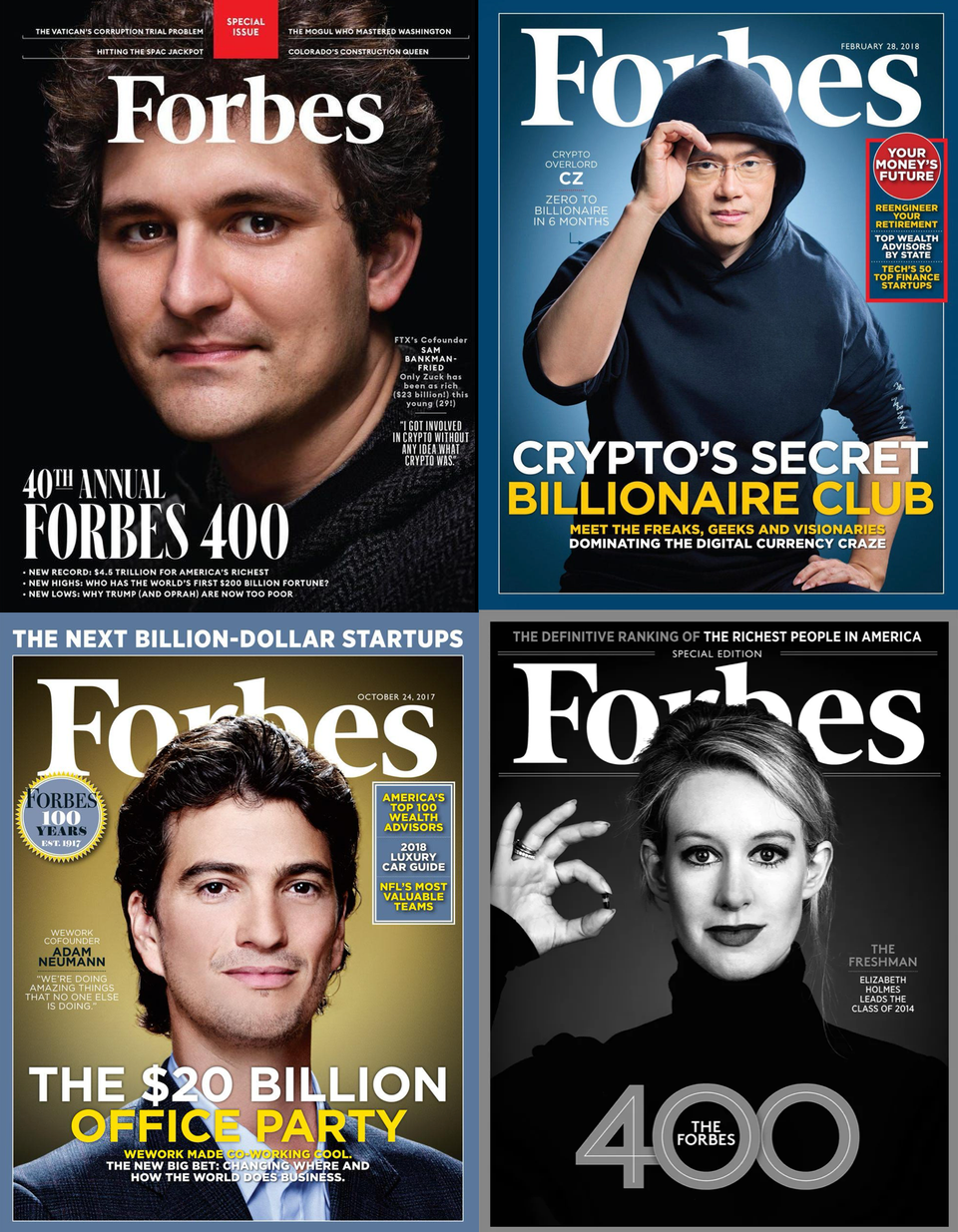
We have witnessed the defenestration of CEOs who have spent years convincing their industry peers — enabled by a largely supplicant technology press corps whose continued access depends on the studied avoidance of critique — of narratives defying corporate, technological, and business logic. Forbes magazine has become a byword for such poetic myopia as a result.
Sam Bankman-Fried co-founded FTX in 2019, a cryptocurrency exchange that became a darling for an insurgent cryptocoin industry — touted as a disrupter to the international banking order and their associated payments infrastructures. At its height, FTX paid to rename the Miami Heat basketball arena (one of America’s largest) in its honour. After the collapse of FTX, Bankman-Fried was convicted of fraud, conspiracy, and money laundering and sentenced to 25 years in prison.
Changpeng Zhao co-founded Binance in 2017, another cryptocurrency exchange that, perhaps due to a combination of Sinophobia and the company’s insistent refusal to be headquartered in any country until 2025 — was always viewed with suspicion by regulators and the wider financial services community. Zhao was sentenced to four months in prison in 2024 for violating US money laundering laws, before being pardoned by the current US president in 2025.
Elizabeth Holmes founded Theranos in 2003, a biotechnology startup that fraudulently claimed to have made groundbreaking advances in blood test diagnostics that was reliant on the small electronic devices they had designed. Investors piled in with over US$700 million chasing the promises that these transformational advances could have in medical interventions. Suspicions were voices from about 2015, and by 2018 charges were brought by the SEC. Holmes was tried and convicted of wire fraud and conspiracy in 2022, and sentenced to 11 years in prison.
Adam Neumann co-founded WeWork in 2010, a co-working company famed for its expensive interiors, ping-pong tables, and beer-on-tap — each emblematic markers of the ludic, pay-as-you-go approach to software development, startup, and office culture that has defined so much of where, when, and how we work with technology today. Famously lossmaking for most of its early years, WeWork was propped up by successive rounds of venture capital by the Softbank Vision Fund before going public using a SPAC, a corporate takeover route acting as a shortcut for companies pursuing a stock market listing. WeWork was declared bankrupt in 2023, and is now under new corporate ownership — but not before disposing of the majority of its real estate and laying off thousands of staff worldwide in successive rounds of redundancies.
So, why recount all of these tales of malpractice, criminality, and corporate chicanery? There is probably a time and place to delve into the minds of this CEO cohort to deconstruct why such people believe their acts could be commissioned safe in the knowledge their wealth and socioeconomic class would insulate them from accountability. Perhaps what draws us to these examples is the fascination that each of these companies continue to possess in the collective imaginaries — not only in technology press, but in the wider news and working cultures. We can cling to our hope that a shift in the political landscape will propel a drift towards better standards of behaviour, before checking ourselves — remembering Mike Monteiro’s words in The Smallest Sliver of Hope (2020), that “Hope is giving ourselves permission to do nothing”.
Theory of the Gimmick
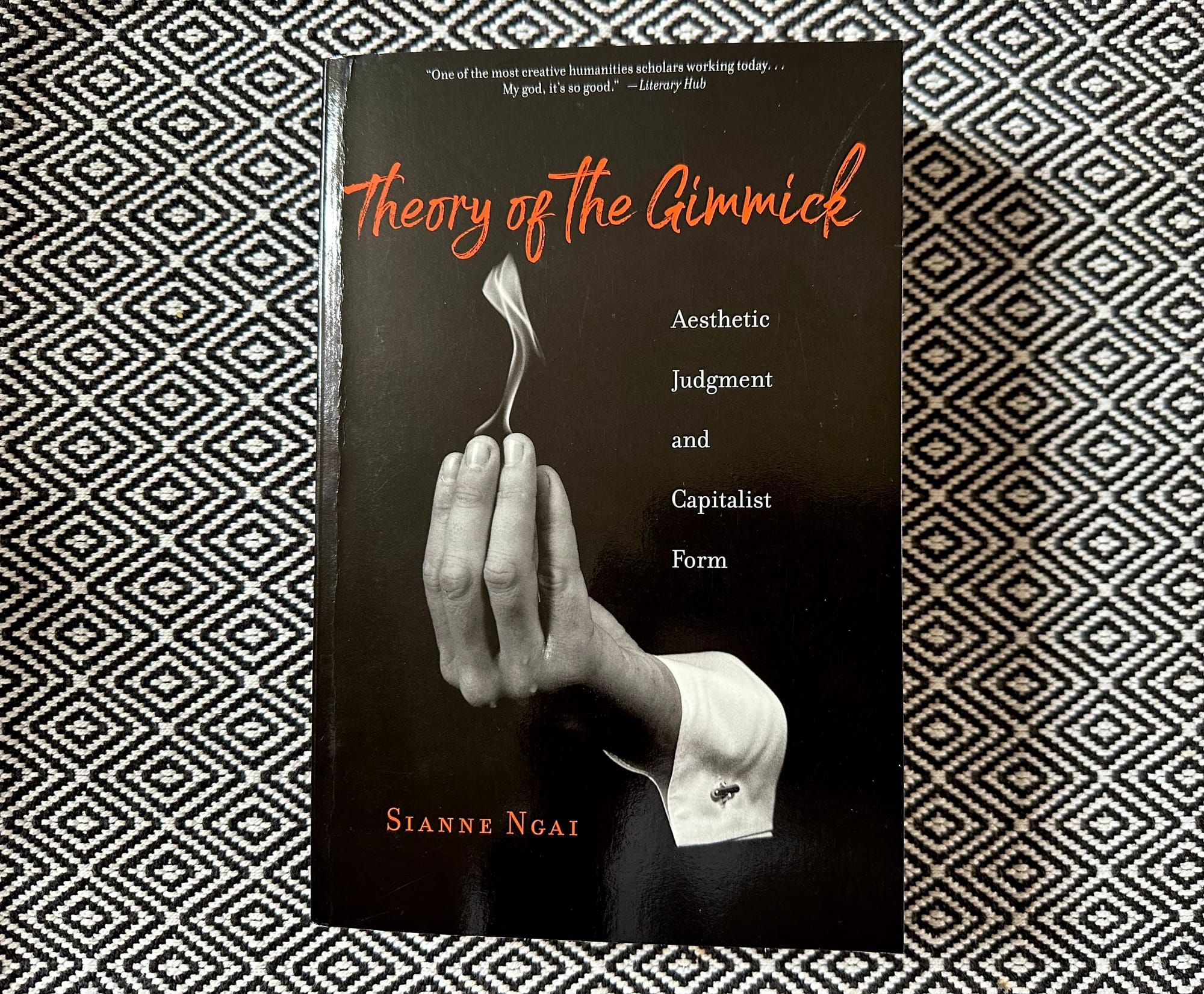
Theory of the Gimmick: Aesthetic Judgment and Capitalist Form (2020) is a scholarly work written by cultural theorist Sianne Ngai. In the book, Ngai argues that gimmicks are recurring devices in capitalist economies that are persistently attractive because — through their aesthetic appeal and promise of unrealised potential — they are bridges between being simultaneously being thrilled and disappointed as we journey towards unrealised levels of efficiency.
Across art, literature, and technology, the gimmick is a device that is both an “aesthetic judgment and capitalist form” that Ngai goes on to describe as:
“… capitalism's most successful aesthetic category but also its biggest embarrassment and structural problem. With its dubious yet attractive promises about the saving of time, the reduction of labor, and the expansion of value, it gives us tantalizing glimpses of a world in which social life will no longer be organized by labor, while indexing one that continuously regenerates the conditions keeping labor's social necessity in place.” — Theory of the Gimmick, pg. 2
Connecting the triple demand to subordinate labour, time, and value to satisfy an insatiable commercial imperative, the gimmick is a shapeshifting entity that excites us — because in it we see the possibility of resolving the intractable problem of inefficiency. However, the gimmick also attracts opprobrium, because by looking past the aesthetic sparkle of its function, we notice how the gimmick is poorly calibrated for solving any problem. As Ngai elaborates:
“The gimmick is a trick, a wonder, and sometimes just a thing. But it is also something accounting for the systematic slippage between these positions, in a way that focusing exclusively on its technological dimension will cause us to miss. Overperforming and underperforming, encoding either too much or not enough time, and fundamentally gratuitous yet strangely essential, the gimmick is arguably a miniature model of capital itself…” — Theory of the Gimmick, pg. 6
So what does the gimmick have to do with technology and their CEOs acting badly?
Pointing out The Gimmick
The gimmick is a natural accessory of the technology industry. It is woven into pitch decks and encapsulated by the impenetrable linguistic metaphors that conjure an aspiration while obscuring the function. The gimmick is repeated until it becomes indistinguishable from its corporate lore. The gimmick is a perpetual presence precisely because the gimmick is a device that captures our attention — elevating our expectations towards the technological wonders we have little-to-no chance of deconstructing or understanding. The gimmick makes it make sense — that we can both mint and be custodians of our own digital currencies free from government interference and regulatory control; that we can be part of a physical social network while eliding the post-2008 precaritisation of the workplace that has decimated the possession of steady employment with benefits; that we can extract more data from a drop of blood than previously though possible.
The technology industry is prone (or perhaps destined) to repeats these tricks, because its things, devices, and protocols are changing in increasingly rapid cycles — the language and devices cannot stand still.
Much like the burghers of Hadleyburg in Mark Twain’s tale who were transfixed by the promise of what their gimmick — the sack of gold coins — might offer if they could only convincingly answer the riddle to secure its possession (“The bulk of the house gazed at it with a burning interest, a mouth-watering interest, a wistful and pathetic interest;”), we too are taken in by the repeated cycles of promise, hope, and disappointment.
We have lived through the promise of AI supermarkets sensing our movements which happened to be powered by workers in India. We are seeing the aggressive implementation of transportation that first offered below-cost cabs — an initial tactic to neutralise existing companies while algorithmically exploiting their drivers — the logic continues as our streets are used as test beds for autonomous vehicles, setting aside the inconvenient truth of the remote control handlers operating in the Philippines. Even if we harbour a healthy dose of curiosity or scepticism towards whichever new gimmick is declared as the answer to whichever transit, logistics, or labour problem is the current barrier to efficiency, the technological gimmick persists in frustrating our ability to scrutinise its inner workings, by dint of its linguistic, infrastructural, and supranational construct. As Ngai observes:
“… protected by its own slickness, [the gimmick is] a thing whose sheer stupidity cleverly neutralizes the critical feeling it incites, the gimmick defends itself from intellectual curiosity in a way that puts any person seeking to analyze it at a comical disadvantage.” — Theory of the Gimmick, pg. 9
“Friends, they are only gilded disks of lead!” [1]
The realisation reverberated through the room like a thunderbolt. The rollercoaster of emotions and collective release of tension that the exposure of the gimmick engenders was palpable. Throughout the story, Twain noted that while gold was present and unclaimed, that so many of Hadleyburg’s residents had become “[so] moody, thoughtful, and absent-minded that he could rob the meanest man in town of a cent out of the bottom of his breeches pocket and not disturb his reverie.” We witness similar moods gripping the billionaire class who are so adept at projecting machinic visions of technological utopia where sociality, relationships, and fulfilment are to be mediated by a privatised networked state — places which Wassim Z. Alsindi critiques as being the “logical next step for technocapital to territorialise, fusing Silicon Valley venture capital culture with nihilistic nation-faith: a place where technocapital be thy God” (pg. 132). Despite the financial windfall these futures promise, these billionaires belie a loneliness and misery that permeates their utopic imaginaries while still being strangely dependent on us to be its subjects.
When the gathered Hadleyburg residents realised they had frantically made themselves miserable in pursuit of a baser metal, we learn “there was a crashing outbreak of delight over this news…” — Ngai’s echoes this sentiment almost a century and a half later, observing that: “The gimmick lets us down—self-corrects our overestimation of its abilities—only because it has also managed to pump us up” (pg. 62).
The vast expansion and capital expenditure required to build these utopic futures are beginning to wobble — and their undoing could be toppled by the scarcity of money, data, or water. Circular investments and polished investment-grade credit ratings for hyperscale data centres threaten to repeat the integration of ‘safe’ debt instruments into the wider investment ecosystem that contributed to the financial turmoil of 2008. Model collapse could beckon as generative AI systems run out of high-quality human made data for its training. Fresh water — an increasingly scarce resource in many parts of the world where climate change and increasing temperature are already increasing, threaten to make data centres the focus of ire in the community poisoned by their presence. As Naomi Klein and Astra Taylor astutely observe:
“Everyone involved in these sectors knows that there is no way to build the artificial mirror world that AI promises to construct without sacrificing this world – these technologies consume too much energy, too many critical minerals, and too much water for the two to coexist in any kind of equilibrium.” — The rise of end times fascism
There is a political economy to the technologies surrounding us, and it is unfortunate that our ability to identify and interrogate these aims are obfuscated by the presence of the gimmick that distract and dizzy our critical faculties. We may like to think of ourselves as incorruptible or immune to the tricks of the gimmick — much like those unfortunate burghers of Hadleyburg — but it is precisely that overconfident self-belief which makes us such ripe targets for the exploitation that the gimmick brings back in different forms, again and again.
Sorry for the plot spoiler, but come on — this story is over 125 years old! ↩︎
Explore further
Further reading
- The Man Who Corrupted Hadleyburg by Mark Twain (1899)
- Inside Tinder: Meet the Guys Who Turned Dating Into an Addiction by Laura Stampler (TIME, 2014)
- Disrupted: Ludicrous Misadventures in the Tech Start-up Bubble by Dan Lyons (Atlantic Books, 2017, 272 pages)
- Brotopia: Breaking Up the Boys' Club of Silicon Valley by Emily Chang (Penguin, 2019, 336 pages)
- Silicon Valley's cocaine problem shaped our racist tech by Charlton D. McIlwain (The Guardian, 2020)
- Theory of the Gimmick: Aesthetic Judgment and Capitalist Form by Sianne Ngai (Harvard University Press, 2022, 416 pages)
- The religion of techno-optimism by Paris Marx (Disconnect, 2023)
- Are You a Software Update? Reader edited by Nora O’ Murchú and Janez F. Janša (Aksioma, 2025)
- Cyberlibertarianism: The Right-Wing Politics of Digital Technology by David Golumbia (University of Minnesota Press, 2024, 480 pages)
- Empire of AI: Inside the Reckless Race for Total Domination by Karen Hao (Allen Lane, 2025, 496 pages)
- File 08: The Real Horror of Frankenstein by Minna Salami (Kaleido: The Europatriarchy Files, 2025)
- Gilded Rage: Elon Musk and the Radicalization of Silicon Valley by Jacob Silverman (Bloomsbury Continuum, 2025, 336 pages)
- How Silicon Valley Unleashed Techno-feudalism: The Making of the Digital Economy by Cédric Durand, translated by David Broder (Verso, 2025, 256 pages)
- Telegram, Pavel Durov and the shaky future for tech's libertarian princelings by Hannah Murphy and Adrienne Klasa (FT Weekend Magazine, 2026)
And finally...
🏴 I will be opening day 2 of UX Scotland (10-11 June), an international conference for anyone working in user experience, human-centred or service design. My keynote is called a firmament inside, and it will be a conceptual art and poetics led approach to examining the effects of self-imposed constraints on our practice. Tickets are available now (discounts for freelancers; scholarships also available).
🇦🇹 I will be speaking on day 1 of uxcon vienna (16-17 September), Europe’s friendliest conference for UX research and design. My talk is about accent bias and speech recognition technologies (with a healthy dose of history and conceptual art) and is called Whose English gets to be default? Tickets are available now.
📣 I have a chapter in the forthcoming essay collection Digital Design for Planetary Care: The Hidden Environmental Cost of the Digital World co-edited by Professors Elio Caccavale and Gordon Hush. The book will be published by Bloomsbury Visual Arts in summer 2027. I will share more information later in the year!
📚 You can buy any book in this newsletter from my store on Bookshop.org (affiliate link)
🗄️ Editions #1–15 of First & Fifteenth were published from 2023 until 2025.