Fifteenth #17: On unlearning
Why do we do research? This might seem like an insultingly simple question, yet perhaps we have never paused to reflect before considering our honest answer. In the quest for a new job or promotion, we might know what an ideal answer should be — or at least have an inkling of the key words to include to signal we are the Right Choice: we gather evidence to inform the design of engaging experiences; we are building digital products to satisfy our clients’ needs; we are part of a collective effort to achieve the strategic goals of the organisations we represent.
From anthropology and archeology, to sociology and ethnography, the histories of empirical research have been derived from what Sasha Costanza-Chock writing in Design Justice (2020) calls “a totalizing epistemology of modernity” (pg. 15) — that is, in the colonial age, the ideological project of scientific research was tasked with flattening the discordant cultures outside of Europe into taxonomic regimes that were ill-fitting containers for the people they sought to make visible and known. Costanza-Chock used this phrase while reflecting on Arturo Escobar’s Designs for the Pluriverse (2018), who set forth an alternative which he calls pluriversal design: “a world where many worlds fit” (pg. xv) — we can and should challenge universal design and its part in positioning White Eurocentricity as the global design standard.
Empirical research in service of capitalism continues these culturally destructive practices, using knowledge systems to create subjects and objects that could be subjugated and exploited in service to capital. Our sponsors have been superseded — once they were expeditionary agents of empire, now they are supranational technology corporations determined to realise a network state.
We possess a shrinking sense of agency within a technology industry that has become increasingly tenuous — personal indebtedness accumulates in cities with costs escalating faster than our earnings can sustain; the right to work determined by visas indelibly linked to contracts renewed on a rolling fixed-term basis. Precarity is now a middle class concern.
The words we use to describe how we practice empirical research are linguistic remnants of past expeditionary colonial projects: discovery to name what is already there; worldmaking that deputises for the patriarchal obsession to reorder knowledge and redefine beings we cannot recognise.
Unlearning citational culture
When the interface to the nascent World Wide Web began to be mediated by search engines, from Altavista to Yahoo!, they each worked in similar ways — by automatically web crawling to construct indexes that could be queried, or navigating by directories on their homepages. When Google was launched, its innovation was through its proprietary PageRank algorithm to assess both the number and quality of links that referenced items in its index. Although this seemed like a subtle distinction. Google applied a decades-old idea well established in academia — in effect, an automated form of citation analysis.
There are more aspects of our online experience that are shaped by citational analysis than we realise and we unwittingly find our behaviours governed by its affordances. Citations define value by the quality and quantity of references associated with a given item. If a journal article or a paper has been cited by 100 reputable peers, then we can agree that it is of a higher value than an equivalent article with 10 citations. But citational practice is not neutral, nor are they any indicator of the reasoning behind why they have been cited.[1] Structural and systemic exclusions that have gatekept many fields in and around computer science means that citational reputation is just as much defined by the missing voices who have never been allowed an opportunity to be recorded, let alone cited. Ruha Benjamin reminds us in Race After Technology (2019) that “Citational practices are political, especially when we start talking about ‘innovation’ — oppressed people and places are rarely cited for their many innovations” (pg. 47). Unthinking and uncritical continuation of these exclusionary structures exist to bolster the walls that have systemically kept out different ways of thinking, knowing, and being.
But this one-dimensional approach to determining reputable knowledge is at the root of how Black cultures and knowledge of their peoples continue to be distorted online — if the mechanism for determining personhood or community is grounded in abuse, misogynoir, and racism, and we rely on systems that calculate the content with greatest quantitative weight must be ranked higher in a search result then, as Safiya Noble warned us of in her prescient work Algorithms of Oppression (2018), we are transmitting and reproducing knowledge formed in environments steeped in “... algorithmically crafted web search that offers up racism and sexism as the first results” (pg. 5).
As we navigate our social media feeds, the algorithms promoting what we see assigns value to content based on the social proof organised by quantified metrics — mirroring our perception of what has more value — so, if a post is liked 100 times, then it has a currency that ranks it more valuable post with 10 likes. Counting his Twitter likes [sic], the philosopher C. Thi Nguyen writing in The Score (2026) points out that “Twitter’s metrics don’t capture the difference between somebody who chuckled for a second at your tweet and somebody who was shaken to their core” (pg. 10) — the scoring system taps into the pleasure systems within our brains, so much so, that we reorient how we present ourselves online to chase the momentary high of receiving a like. Nguyen continues, “We become beholden to what everyone can understand” (pg. 24).
If citational metrics are the building blocks, motivators, and memetic tokens for publishing our knowledge online — these selfsame factors emerge from cultural exclusionary foundations (at best) or reifying agents that transmit networked expressions of memetic antiblackness (at worst), then we must ask ourselves how we can reimagine our engagement with citational practice to recast how we make and distribute knowledge online.
We need to go beyond making citational adjustments to refer to works of those who have been underrepresented. Tanja Bosch, Professor of Media Studies and Production at University of Cape Town, argues that our interest — if it is one motivated by seeing in true structural change — will inevitably lead to a reorientation of the way we collectively produce knowledge:
“To cite differently, then, is not merely an ethical gesture, it is a political and methodological intervention. It is a means of building solidarities, unsettling established authority and reimagining what it means to think, teach and theorise collectively.” — Decolonisation is not a vibe
To unlearn citational culture is to liberate ourselves from the expectation of mechanisms that cannot adequately frame our Blackness. As Fred Moten comments during BLKNWS: Terms & Conditions (2025), we contend with archives that “… [use] words that don’t correspond to the situation”. To unlearn citational culture is to choose to express ourselves online in a way that is not subject to the algorithmic ordering of an automated content machine into which memetic antiblackness is the quantitative multiplier determining who gets to be seen, celebrated, and heard.
Seneca Fall Convention 2048
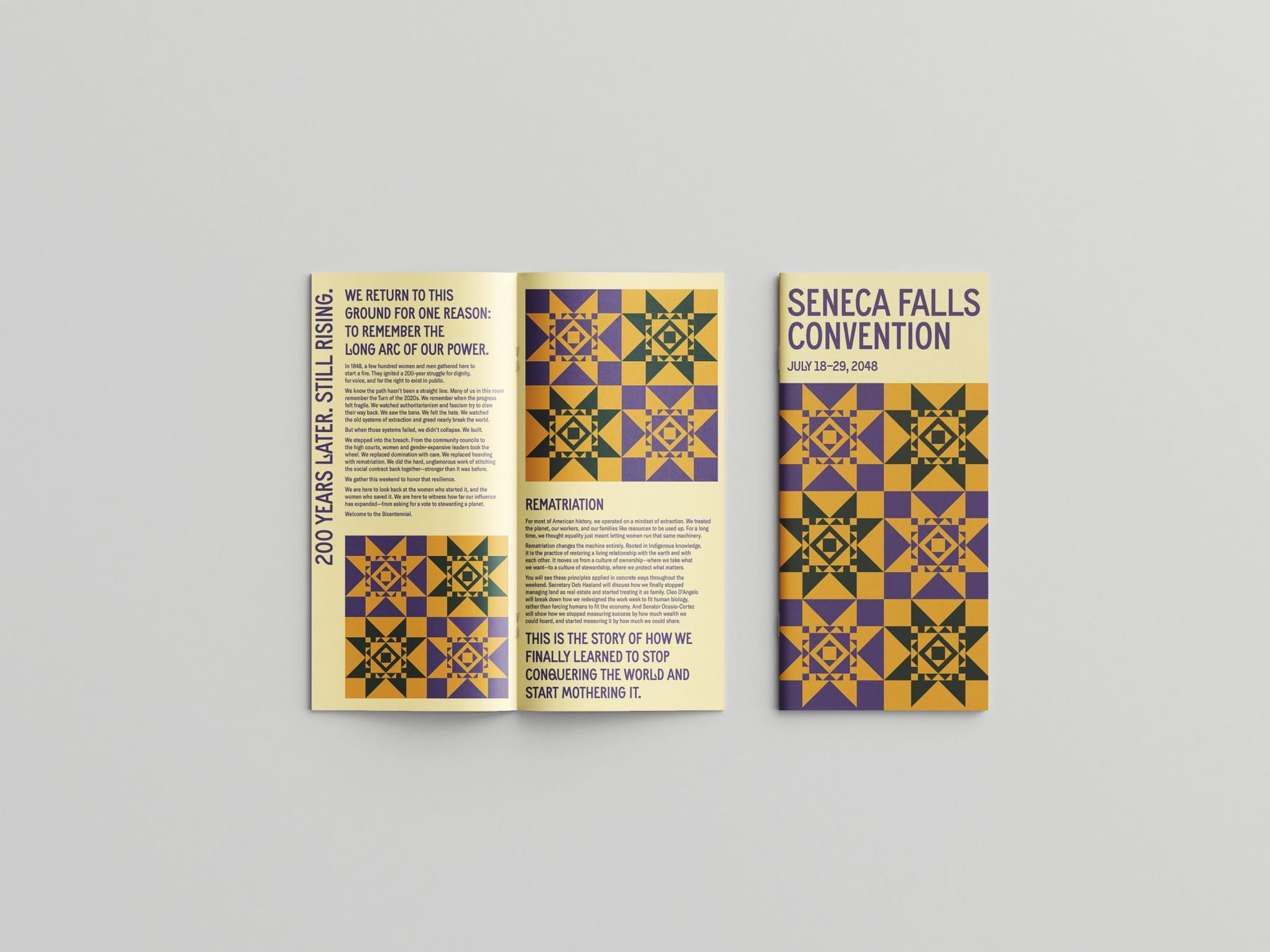
July 2048: on the occasion of the bicentenary of the Seneca Falls Convention for universal suffrage in 1848, the forthcoming convention explores four themes central to the continuance of matriarchy and care-as-infrastructure that has been so well established in public life. With the social, geopolitical, and infrastructural damage of the turbulent MAGA years an increasingly distant memory, the women in public life invited to this two-day convention — many of whom were, at times, directly involved and at times in grave danger of punitive actions by past patriarchal authorities — will share in a series of roundtables and stewarded discussions.
Seneca Falls Convention 2048 is a speculative design fiction project by Tracee Worley of Radical Futures. Published online in 2026, at the height of a fast-paced, chaotic, sequence of geopolitical state-backed outrage — at home and abroad — the work is a defiant statement compelling us to imagine, think, and speculate as a reclamation of imaginative agency. Ruha Benjamin writing in Imagination: A Manifesto (2024) reminds us that “... those who monopolize resources monopolize imagination” (pg. 21). The collective inertia pinioning those of us concerned with advocating for equitable futures, has resulted in a settled feeling of uselessness — making us feel like passive observers to the prosecution of outrages directed towards minorities, women, and migrants.
To make our desired futures real, we must channel our imaginative energy to create something beyond the page or whiteboard — and this is what Tracee Worley has achieved in this speculative design fiction project. We have written papers, attended seminars, speculated and dreamed while the funding for initiatives and projects so enthusiastically launched to promote inclusion and rectify racial injustice during the 2020 awakening have been swiftly mothballed.
Seneca Falls 2048 is a refusal to let our current technofascist patriarchal turn diminish our capacity to imagine otherwise in the face of algorithmic regimes aspiring to reshape our world. Nastasia Hadjadji and Olivier Tesquet writing in Apocalypse Nerds (2025) give us a vivid image of these regime’s characteristics:
« Ce que nous proposons d'appeler technofascisme n'est pas la simple adjonction de gadgets sur un vieux corpus autoritaire: c'est un nouveau régime d'action, modulaire, distribué, post-idéologique, où l'autorité s'administre comme un service et se déploie à l'ombre des institutions qu'elle aura préalablement affaiblies... Le technofascisme n'a pas de manifeste, mais il a un design. C'est un logiciel en train de réécrire le monde, qui distribue l'autorité par l'infrastructure; un double effet de centralisation et de décentralisation. La royauté conjuguée à la blockchain. »
[”What we propose to call technofascism is not simply the addition of gadgets to an old authoritarian system: it is a new regime of action, modular, distributed, post-ideological, where authority is administered as a service and deployed in the shadow of the institutions it has previously weakened. Technofascism has no manifesto, but it has a design. It is software rewriting the world, distributing authority through infrastructure; a dual effect of centralization and decentralization. Royalty combined with blockchain.”] — Apocalypse Nerds (my Google-aided translation), pg. 18
Seneca Falls 2048 shows us how our desirable futures can be reimagined in a way that is unencumbered with the need to maintain interaction with aggressive technopolitical moment that never included or protected the rights of minorities, women, migrants, or the planet. Seneca Falls 2048 skips straight to the conclusion: matriarchy and care-as-infrastructure is already well-established — inviting the people doing research to think back from this point to clarify the orientational adjustments we must make from the present to ensure we do not hinder its arrival.
“We create beautiful chaos” [2]

When I think of turning thoughts and theories into actions in my design research practice, I am inspired by an essay recently published by Sabrina Meherally, founder of decolonial design studio Pause and Effect, called The version of research we actually need, which opens with an untitled poem:
Tiny stars fall from the sky
And cling to each other
Changing terrain
Amplifying light
Stopping time and traffic
As if to remind us
That we will not disappear in the cold
That together
We create beautiful chaos
— Untitled poem by Sabrina Meherally
We have been inured to the possibility of contemplating how or why design has been an immovable agent for imposing Eurocentric ideals — using the language of universalism to elide its deleterious effects on Black and Indigenous cultures around the world.
The stories we learn to retell in our design work are narratives that simultaneously flatten while fashioning hierarchies — of knowledge, taste, and the cultures perceived to be authors of such standards. In The version of research we actually need, Meherally reminds us that research is both “a site of narrative power and narrative change”.
Meherally argues that our work is so much more than observing, collecting and synthesising data. We may think of ourselves as dispassionate observers, little realising we act as agents of modernity — by which she means we are acting as disembodied beings with no connection to the planet, lands, or its peoples. Our theories of knowledge — indeed the design canon we have been instructed to consume tells us of a single way to make sense of the world around us, causing us to ride roughshod over the different ways of knowing that we may encounter in our surroundings.
In all of my training, I seldom remember encountering the word “responsibility” applied to my practice, apart from when being instructed about the duty we have to the client paying our invoice — regardless of their values or morals. Meherally refuses the passive interpretation of how researchers must work, because:
“… research literally shapes the way people conceive the world. And even at the smallest scale, our decisions matter: who we listen to (and how we listen), the stories we choose to tell (and how we tell them), the way we hold space for knowledge (and how we implicate ourselves within it), and what we do with what we know.” — The version of research we actually need
One of the points I make in my forthcoming essay on human-decentred design being published next year, is how we must refuse many of the ‘oughts’ we have internalised as perennial indicators of how design must be done. From a position of diasporic unbelonging, we refuse the equation of whiteness with universal design language; we refuse to be bound by a single ethnic or cultural marker, when such imposed terms fail to represent our own beautiful chaos — they do more to constrain our imaginative possibility of how we create, rather than liberate.
Meherally observes that we live in a “beautiful, chaotic, messy planet” and as designers whose primary concern is to impose order, the realisation that there a perpetual, untameable chaos is a truth that may be in equal parts alarming and reassuring. We should discard the patriarchal urge to frame our work as worldmaking and accept the chaos and our tenuous position within its discordant pieces.
What have you (un)learned today?
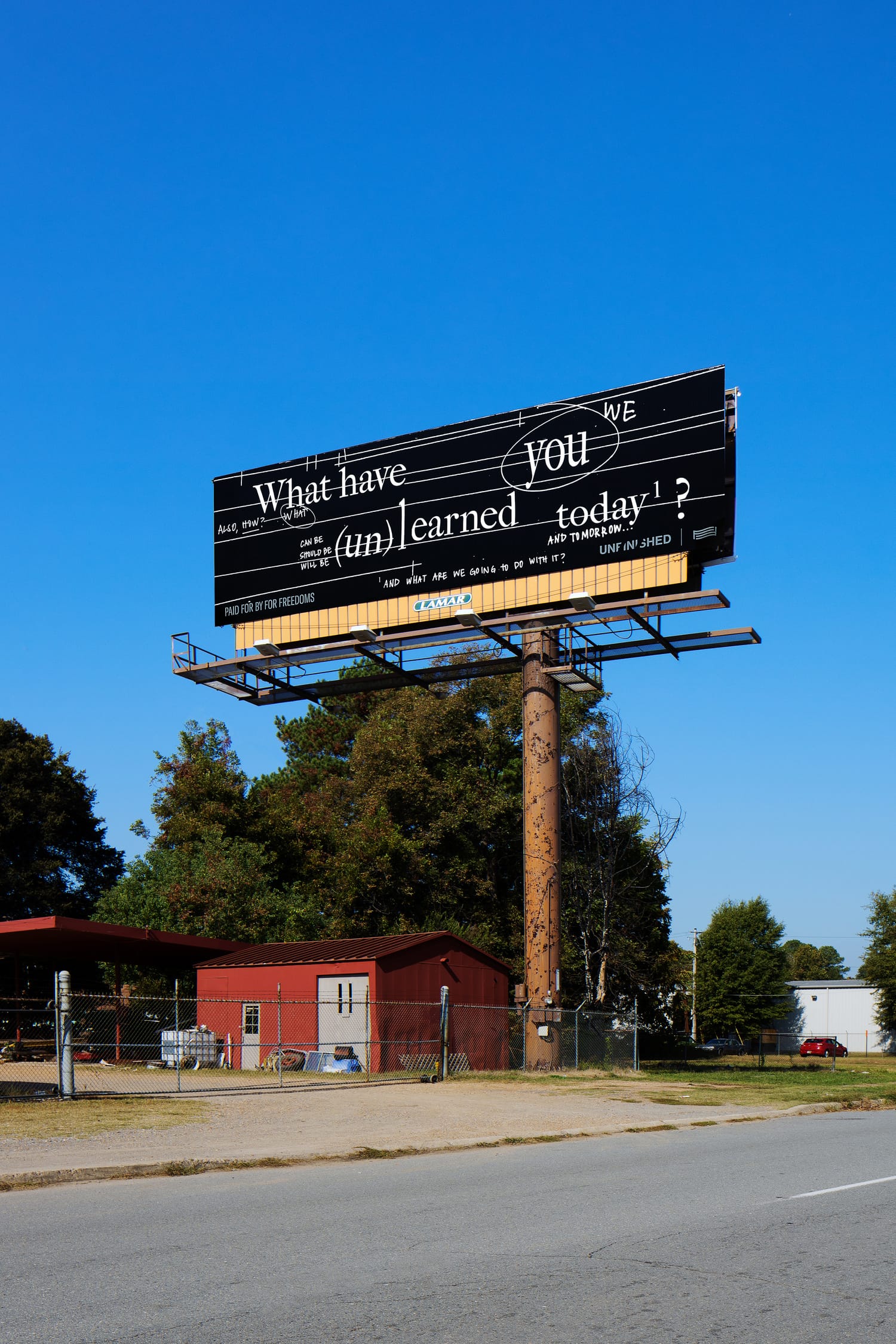
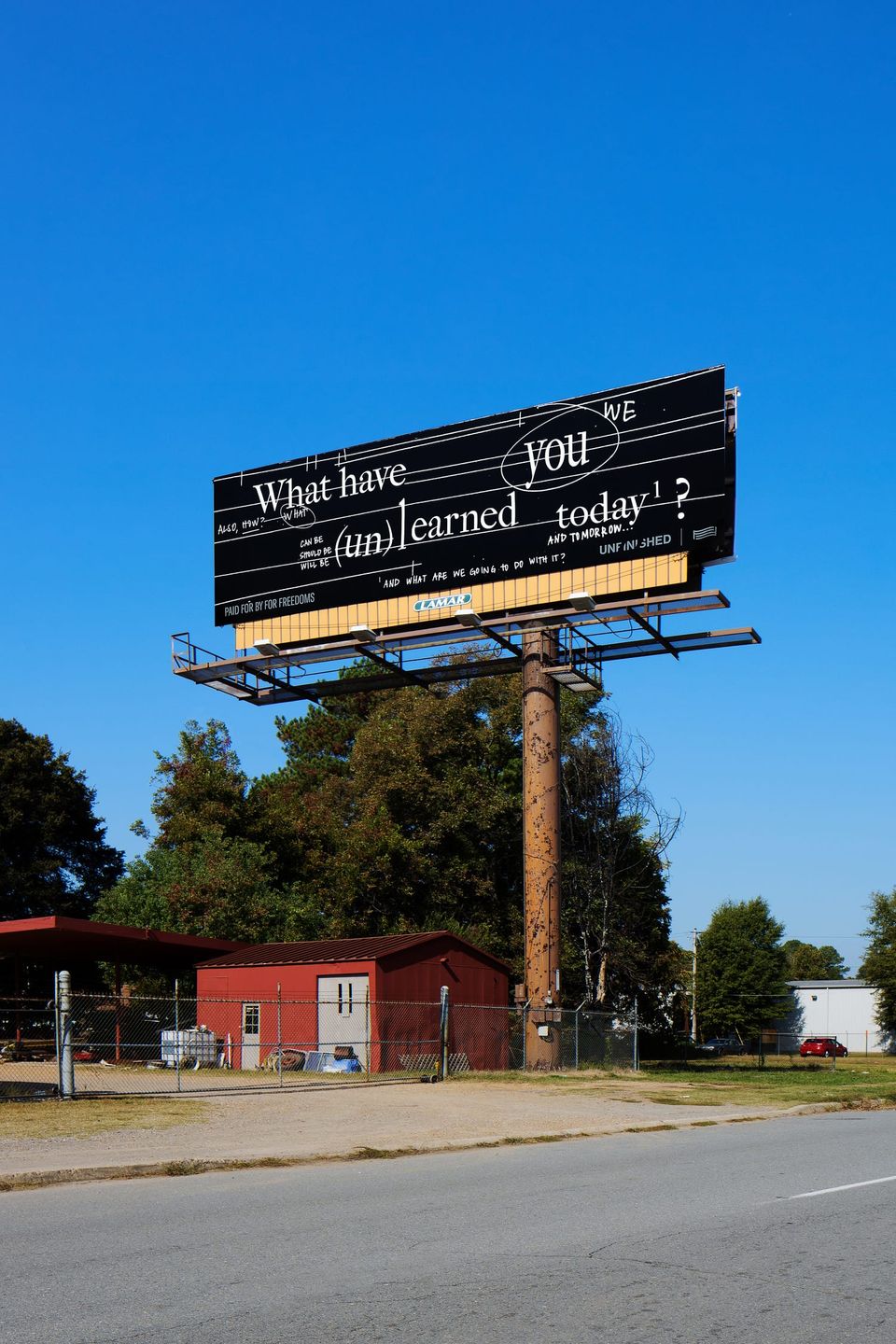
Returning to the question posed to us by billboard by Kameelah Janan Rashad in this essay’s main image — we ask ourselves, What have you (un)learned today? [3]
Rashad’s billboard was exhibited as part of For Freedoms, a nationwide project in 2020 inspired by the abolitionist movement that propelled Abraham Lincoln to power centuries before. We might not think systemic change is possible when starting a standing start.
We can unlearn our acceptance of the discriminatory status quo. We can unlearn the ways we ought to accept the singular narrative of the technosolutionism and inevitability narrative surrounding innovation, and Big Tech’s insertion as a non-negotiable mediator for these futures. We can unlearn our internalisation of respectability politics that has told Black folk for more decades than I care to count to wait for the right time for reparative justice to be distributed — like Tracee Worley has shown us, we can and should make our desired futures, make them real, and make them known. We must unlearn the extractive modes of empirical research and contend with their origins in the colonial project — imagining what the work of a researcher should be when working towards liberatory futures.
The technology industry has played a linguistic masterstoke in dubbing us individual contributors. This term has done so much work to diminish the perception we have of the agency we possess. We are far more than this.
Our role, as Sabrina Meherally writes “… is not simply to produce more information. It is to resist erasure. To be the thorn. To become stewards of stories, not extractors of data. To bear witness and tend to the conditions under which knowledge lives.” If we can grasp this idea and activate its meaning, we will be reminded that we are truly working collectively, and truly contributing — not to the demands of an extractive corporation, but to the furtherance of our liberatory aims.
Safiya Noble discusses the reasoning behind this point at length in Algorithms of Oppression (2018), writing on page 39, that “... in the process of citing a work in a publication, all citations are given equal weight in a bibliography, although their relative importance to the development of thought may not be equal at all.” Citations do not communicate how they were received — were they agreed or challenged? — which are important factors for determining their weight, nor do they capture the reputations of those who can communicate their knowledge outside of formal citational practices. ↩︎
Quote from Untitled poem (2026) by Sabrina Meherally, featured in The version of research we actually need. Image used with kind permission of Sabrina Meherally. ↩︎
What have you (un)learned today? Adhesive Vinyl on Billboard, 237 x 144 inches (For Freedoms, North Little Rock, Arizona, 2020). Photo Credit: Jonathan Dean. Photo used with kind permission and courtesy of Kameelah Janan Rasheed Studios. 🖤 ↩︎
Thank you 🖤
🫂 Tracee Worley of Radical Futures, for allowing me to reproduce your Seneca Falls Convention 2048 image and for your input on my draft of the text about your work.
🫂 Sabrina Meherally of Pause and Effect for allowing me to reproduce your poem, and for the inspiring conversations we have had in the lead up to this essay. The closing line of your essay continues to reverberate with me: “The researchers this moment needs are not simply more skilled. They are more awake — to power, to relationship, to the living world.”
🫂 Kameelah Janan Rasheed Studios for giving me permission to use your artwork as the lead image for this essay. Kameelah’s practice is expansive and thought-provoking. I am sure I will be discussing Kameelah's work again in the future.
Listen


Clever with Amy Devers, 4 April 2023, 47 mins
Pocket Casts
World of Wisdom, 30 July 2024, 1 hour 7 mins
Carceral Fictions and Abolitionist Realities, 5 February 2025, 1 hour 41 mins
Pocket Casts
Overthink, 14 October 2025, 57 mins
Futur-ish, 19 March 2026, 30 mins
Transcripts are available for Imagination, The Movement Charging You to Disconnect (with Tracee Worley), and Degrowth.
Further reading
- Pedagogy of the Oppressed by Paulo Freire (Penguin Modern Classics, 2017, 160 pages; first published 1968)
- How to Cite Like a Badass Tech Feminist Scholar of Color by Rigoberto Lara Guzmán and Sareeta Amrute (Data & Society via Medium, 2019)
- “Techno-Vernacular Creativity and Innovation across the African Disapora” by Nettrice R. Gaskins, taken from Captivating Technology: Race, Carceral Technoscience, and Liberatory Imagination in Everyday Life edited by Ruha Benjamin (Duke University Press, 2019, 416 pages)
- Letters: The classroom is burning, let’s dream about a School of Improper Education by KUNCI Study Forum & Collective (Ugly Duckling Presse, 2020)
- Mabel O. Wilson on Radical Optimism (PIN-UP, 2021)
- On getting to the root of things by Ari Melenciano (The Creative Independent, 2025)
- The Alchemy Lecture 2023: Five Manifestos for the Beautiful World by Phoebe Boswell, Saidiya Hartman, Jainína Oliveira, Joseph M. Pierce, and Cristina Rivera Garza, introduction by Christina Sharpe (Alchemy by Knopf Canada, 2024, 168 pages)
- Why don’t we cite African women? by Neema Iyer (2023)
- Imagination: A Manifesto by Ruha Benjamin (WW Norton & Co., 2024, 192 pages)
- Mothering Economy by Jenny Grettve (Plastic Letters Press, 2024, 158 pages)
- Can Feminism be African?: A Most Paradoxical Question by Minna Salami (William Collins, 2025)
- Decolonisation is not a vibe: On anti-capitalist praxis, citation politics and epistemic refusal by Tanja Bosch (Media, Culture & Society, vol. 47, no. 8, 2025)
- Every Monument Will Fall: A Prehistory of the Culture War by Dan Hicks (Hutchinson Heinemann, 2025, 592 pages)
- Friction 3: Who Gets to Be Critical in Design? by Raquel Lima (Systemhood.design, 2025)
- The version of research we actually need by Sabrina Meherally (2026)
And finally...
🏴 I will be opening day 2 of UX Scotland (10-11 June). My keynote is called a firmament inside, and is a conceptual art and poetics led examination of how self-imposed constraints curb our capacity for enacting systemic change. Tickets available now (discounts for freelancers; scholarships also available).
🇦🇹 I will be speaking on day 1 of uxcon vienna (16-17 September). My talk is called Whose English gets to be default? and is about accent bias and speech recognition. Tickets available now. Use my personal code MICHAELUXCON to get 10% off!
📣 I have a chapter in the forthcoming essay collection Digital Design for Planetary Care: The Hidden Environmental Cost of the Digital World co-edited by Professors Elio Caccavale and Gordon Hush. The book will be published by Bloomsbury Visual Arts in summer 2027.
💳 If you like what you have read, please consider supporting my independent practice with a one-off £10 donation. That will be a welcome contribution towards the ongoing costs of keep this website running!
📚 You can buy any book featured in this newsletter from my page on Bookshop.org (affiliate link)
🗄️ Editions #1–15 of First & Fifteenth were published from 2023 until 2025.