Fifteenth #18: On the slopcore aesthetic

There is a strange glaze mediating your perception of the synthetic images in your feed. At first glance, you sense the altered luminescence before concluding it’s a visual shift that does not need comment.
I have noticed a recurring visual signature in AI-generated images as they have become more widely used within and beyond specialist design software, regardless of whether the results are convincing imitations of well-known artists and animation studios, or are part of the emerging genre of AI slop — banal or nonsensical images too strange to be described, created, and distributed on social media in the hope of achieving virality. The sheen through which these synthetic images are viewed have become reliable markers of the generative AI responsible for their existence, if we know how to name them.
In 2019, a scene from The Real Housewives of Beverly Hills garnered attention from fans of the show and tabloids that followed up in its aftermath. A still from one of the scenes erupting from an argument involving Armstrong pointing in tears while being consoled by Richards unwittingly became internet folklore. Now a perennial part of internet meme culture, in its final form, Armstrong is juxtaposed against a deadpan white cat sitting at a table. If you have not been extremely online in the last 5 years, I realise the semantic absurdity of these preceding sentences.
In our information-saturated online age, what makes memes such an effective communication tool is the way they reliably reference a shared technocultural understanding from a single visual reference point. Woman yelling at cat represents the absurdity of refusing to yield a dogmatic position when confronted by a devastating counterargument. Woman yelling at cat represents arguments ranging from the profound to the trivial; its perpetuation can also be a troubling commentary on the ways in which women’s emotions are trivialised or treated as fodder for ridicule in online discourse.
Fast forward twenty years or so and I am confronted by a generative AI version of this meme coated in even more technocultural objects. The resulting image is a visual palimpsest: woman yelling at cat mashed up with the bearded man from American Chopper argument rendered in the style of Studio Ghibli’s hand drawn animation — a synthetic image which could only be a produced since GPT-4o, OpenAI’s 2025 release.
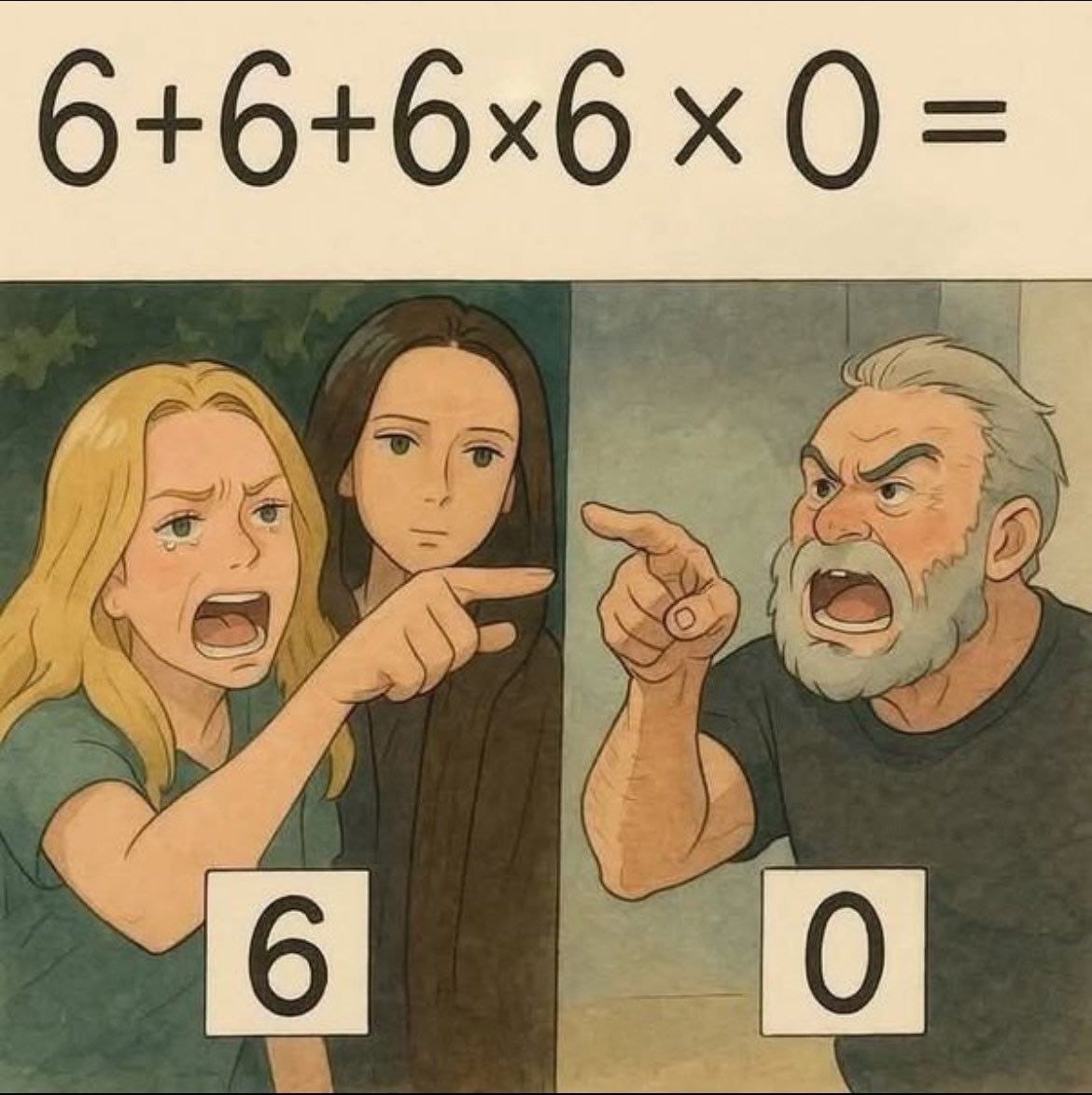
Generative AI images are derivative products algorithmically genearated from vast image datasets in response to a user’s prompt. In a figurative sense, it is as if the vast palette extracted from thousands of years of art and illustration has been rendered into a viscous beige reduction from which these synthetic byproducts emerge. Do you see the glaze?
As I encounter increasing numbers of synthetic images across my social media feeds, there is a persistent off-white glaze giving a clue to their machinic provenance. Their adulterated origins cannot free themselves from the remnants of thousands of paintbrushes, pens, and pigments that have given GPT-4o and other generative tools the capability to mimic an artist’s work. Hovering my mouse, the visual filter acts as a digital laminate that cannot be peeled from the synthetic image beneath. The conclusion I reach poetically testifies to its prosaic actuality: the closest match I find using my digital colour metre sums up the glaze in a mysterious code — 12-0712 TCX, otherwise known as vanilla in Pantone’s proprietary colour matching system.
I have tested this with various synthetic images appearing in my social media feeds and this is the nearest approximation of the glaze, again and again. Vanilla is the algorithmic by-product of Big-Tech’s treatment of artistic expression as they desperately propel the adoption of their algorithmic generation tools. Vanilla is the visual residue of the centuries of pain, experimentation, trial-and-error, and discarded sketches that are component parts of the artistic landscape we recognise and cherish. Vanilla is the mechanical extract squeezed from these artists’ hands, forgetting their obsessive quests to reproduce a single colour or the wars nations have waged to control the production of a single dye. Vanilla is the indelible layer mediating our interpretation of these synthetic images — its off-white presence functioning as digital aspic to preserve an artefact that has never been imbued with vitality.
Brain Rot, AI Slop and the Enshittification of the Internet
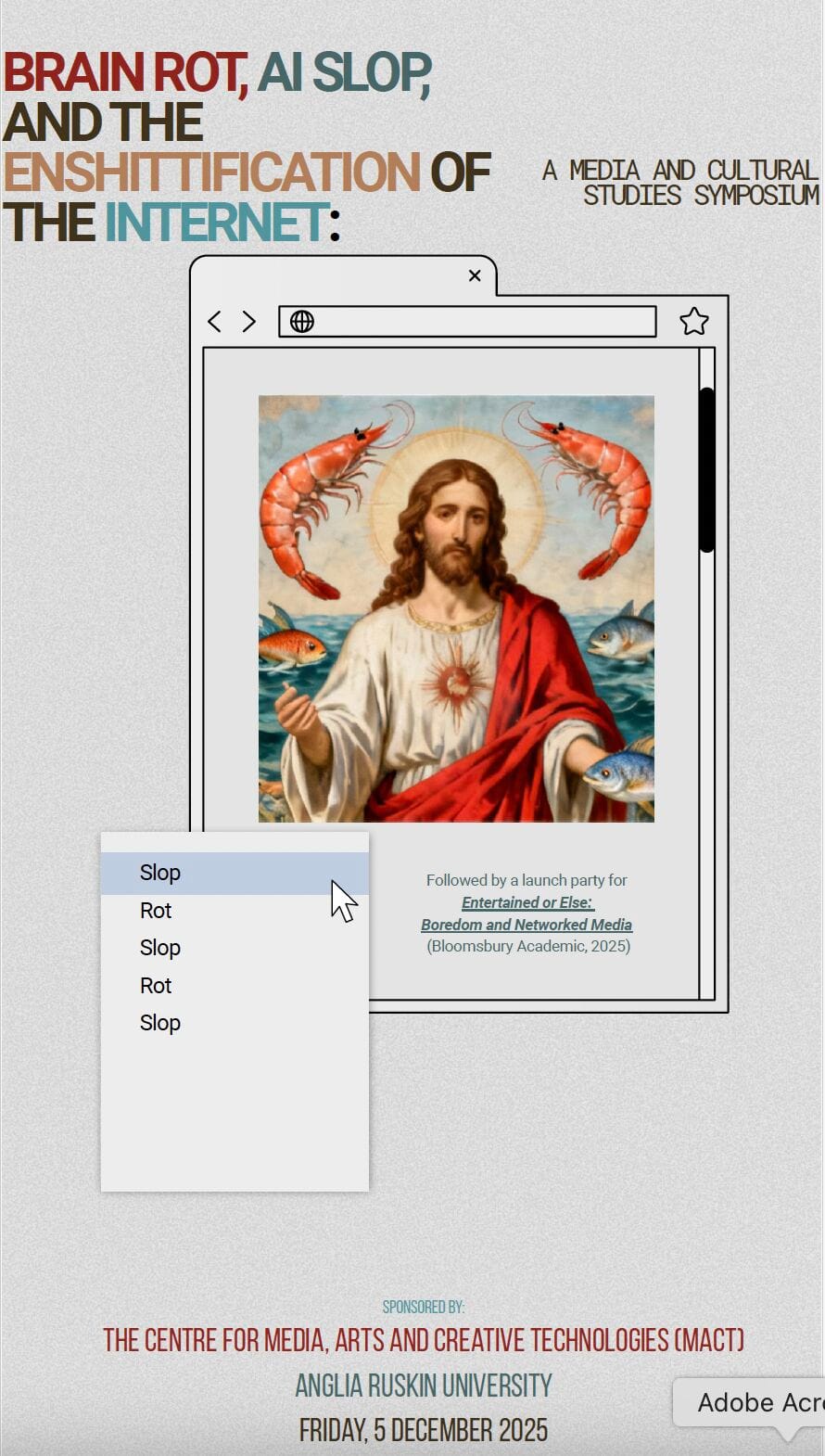
What possible value can found by inspecting the algorithmically generated detritus clogging up the internet? [1] Thankfully I found a cohort who were equally curious to seek answers to this question when I attended Brain Rot, AI Slop and the Enshittification of the Internet, a one day symposium hosted by The Centre for Media, Arts and Creative Technologies (MACT) at Anglia Ruskin University in Cambridge last December.
The symposium gathered researchers, artists, and technologists at varying stages of inquiry about this rapidly mutating networked visual culture whose purposes are shifting faster than can be reasonably documented.
Tina Kendall, Associate Professor of Film and Media at Anglia Ruskin University, opened the day by giving us a tour of the origins of brain rot and AI slop and how the increased integration of automated generative AI tools are simplifying the creation and dissemination of content of an ever degrading quality. While we are locked in a perpetual struggle to contain our impulses for mindlessly scrolling our neverending feeds, brain rot acts as a topically administered numbing agent to dull our senses from the unprecedented extremes we are being algorithmically forced to contend with daily.
Maria Gemma Brown, PhD Candidate at University of Queensland presented the results of a longitudinal study among Australian young adults of how AI slop already shapes the consumption of advertising on social media. The window we were given into their online worlds made a very uncomfortable truth apparent — the ease with which the seemingly passive activity of endlessly scrolling through AI slop is an activity we are poorly equipped to control. Brown argues that this is content designed for the endless scroll, and once hooked — as so many of Brown’s participants showed — we are seamlessly introduced to indistinguishable adverts which soon introduced passive income schemes, sports betting, crypto, and other scam adjacent products.
Unlike flicking through TV channels, the online version is optimised for us to never quite reach the level of boredom to consider pulling ourselves away. The lure of the infinite scroll is magnetic. As one of Brown’s subjects commented:
“I think majority of the stuff online is brain rot... Because it's just so mindlessly, like, uninteresting... well maybe not uninteresting because it is interesting hence you are still watching it… Maybe it's the fact that it's devoid of intention from you, where it's like, you're not trying to find out that content itself.”
These feeds continue to be a hypnotic, numbing yet soothing pastime, acting as a respite from the trauma of consuming content designed to constantly eomtionally provoke us in the name of engagement.
Fruitslop
⚠️ This section discusses racism, misogyny, and homophobia, and links to a video that critically examines animated shorts you may find offensive to watch.
For all of the ills associated with images made with generative AI, there is at least a surface level pretence of aspiring to resemble an artistic object. Brain rot, however, exists to massage the least common denominator within our attention. The content needn’t even make sense — starting with #Brainrot on TikTok, it isn’t long before we find ourselves in weird sub-cultures from #ItalianBrainRot — Ciao Blueberrinni Octopussinni! Ciao Trulimero Trulicina! — before the algorithm does the rest to make the hours evaporate.
AI slop — and its emerging mutant cousin, fruitslop — is a data-driven distortion optimised to simultaneously entertain, confuse, and overwhelm our sensibilities. If you have had the misfortune to have stumbled upon fruitslop, you will recognise its backing track.
Closer examination of fruitslop reveals we are ingesting videos that surreptitiously excuse misogyny and the public humiliation of women, normalise rape culture, glorify anti-miscegenation, and promote homophobia — neatly wrapped in a two-minute short.
I am reminded of how Blackness and the meme collide. It is Legacy Russell’s Black Meme (2024) reborn for the generative AI age. These troubling themes are by-products of a data-driven analyses of what addictive content for men’s basest prejudices must contain. Tonia Sutherland, Associate Professor of Information Studies at University of California, reminds us in Resurrecting the Black Body: Race and the Digital Afterlife (2023) “…the social apparatus of visual media that documents anti-Black violence in the United States [and beyond] is — and has always been — impelled by racism, enabled by technology, and motivated by profit” (pg. 10). These visual outrages will always be thus.
Rolled into a single piece of content, many of these shorts animate talking points common in the manosphere — that men are useless unless they are financially and physically dominant, that women conspire to sexually humiliate men, so in kind must be treated as sex objects to be used and discarded as a preemptive measure. Fused with age-old racist tropes covertly wrapped within the veneer of Pixar-like animation, fruitslop is a cynical ploy to use cute animations as a bridge for algorithms to calculatively identify enough similarities so that they can be seamlessly recommended on platforms, like TikTok and YouTube, to unsuspecting children and adults alike.
Gimmicks and gallerte
Back to the symposium and Ludmila Lupinacci, Assistant Professor in Digital Media at the University of Leeds co-presented a paper with Idil Galip, lecturer in New Media and Digital Culture at the University of Amsterdam specialising in meme studies. In their work, they have turned their attention to ways in which cultural production is being deskilled to such an extent that many creators happily offload their work to a mechanised corporate prediction machine. Years ago, to come anywhere close to producing an animated short required teams of artists and scriptwriters at the very least. Today, the only constraints are the linguistic limits of a creator’s imagination and what they can describe in a prompt. Lupinacci and Galip remind us that AI slop’s operational aesthetic, once recognised as exposed trickwork, are tell-tale markers betraying their synthetic origins — AI slop is truly a gimmick.
AI slop also lends itself to metaphorical reconstitution. Daniël de Zeeuw of University of Amsterdam likened its existence to computational gallerte or, a gelatinous blob — a fitting metaphor as we gorge ourselves on images requiring no effort to conjure, little knowing the nutritional deficiencies we are storing for ourselves in the future. In “Computational Gallerte: Compressions of Culture”, the paper de Zeeuw wrote as the basis for his presentation, he uses Karl Marx’s theorisation of how market value is extracted from the mass of human labour in factories, and using this imagery to form a parallel understanding of “… how AI systems deploy specific scientific techniques of aggregating, distilling, and compressing data, as the intermediary product of public and cultural labor.”
Gelatine was once thought to be a magical solution for feeding the masses. The confluence of applied chemistry, biology, and maths produced a low-cost nutritious wonderfood through distillation, compression, and extraction — a promise that the emerging food science industry has repeated itself in different forms in the centuries since. Gelatine exists as a metaphoric reflection of what AI slop promises to us today. de Zeeuw reflects that “it is not the manually laboring body of the worker that is being boiled down and objectified as commodities, but the cultural and expressive life of the thinking, feeling, and social body that is absorbed and compressed into a statistical aggregate, a stochastic jelly of human expressivity”.
Reflecting on the symposium, I came away with the view that our contemporary technoculture is determined for us to perceive AI mediated creativity as being defined by the bloodless tropes of blue, clean and smooth surfaces — the very antithesis of the toil, deep research, and imperfections that trouble artistic pursuits. These digital futures exist in a generative AI stack mediated by corporations determined to extend their infrastructural control of artistic expression. If this is what creativity must become, I ask again — do you see the glaze?
You have reached the end of the feed
In the few months since this symposium ended, the landscape of brain rot and AI slop has already shifted. In just under a year and a half, OpenAI’s Sora has been launched and shuttered; Iranian content creators have opened a new propaganda front by reappropriating Western cultural symbols to make Lego hip-hop slopaganda trolling the US administration. Record producers are salivating at the prospect of jettisoning recording artists. AI slop continues to take over our feeds — with examples of far-right content surging in the UK being exposed as the product of content creators in South East Asia, lured by the ability to get rich quick — we are subject to the lengths that a few content creators will go to create easily monetisable content at scale.
Perhaps we are heading towards a post-social media age — as theorised by academics Petter Törnberg and Richard Rogers in a recent preprint — an age where synthetic content circulates, scales, and competes within platforms originally designed for human expression, run by companies who have little to no incentive to intervene when synthetic and human-created content attract comparable engagement.
The content demanded by our algorithmic feeds demands a never-ending supply of novelty, and — like grist for the mill — this is where the new generation of AI slop finds its purpose. We must be constantly engaged — what Tina Kendall calls “compulsory continuous connectedness” (pg. 15) in her examination of the monetisation of boredom under digital capitalism in Entertained or Else: Boredom and Networked Media (2025). For many consumers lost in the depths of the infinite scroll, the digital numbness brought on by watching brain rot is a salve for the assault on our senses in our synthetic technocultural age.
AI slop represents the belief that creativity can be deconstructed into its atomic parts and mechanically reconstructed through automation to produce soulless simulacrums of artistic expression. It is unfortunate that a spice as noble as vanilla is now besmirched by its figurative association with these synthetic visual products.
Listen
 Pocket Casts
Ten Thousand Posts, 27 August 2024, 1 hour 10 mins
Pocket Casts
Girl Employee, 21 October 2024, 34 mins
Pocket Casts
Tech Won't Save Us, 1 May 2025, 53 mins
Pocket Casts
The Documentary, 27 August 2025, 21 mins
Pocket Casts
Word of Mouth, 21 September 2025, 28 mins
Pocket CastsTen Thousand Posts, 31 March 2026, 1 hour 12 mins
Pocket Casts
The Allusionist, 13 April 2026, 41 mins
Transcripts are available for 225: Hues.
Further reading
- The Secret Lives of Colour by Kassia St. Clair (John Murray Press, 2018, 328 pages)
- How to Read an AI Image by Eryk Salvaggio (Cybernetic Forests, 2022)
- Black Meme: A History of the Images that Make Us by Legacy Russell (Verso, 2024, 182 pages)
- No Targets, Just Vibes: Tuned Advertising and the Algorithmic Flow of Social Media by Maria-Gemma Brown, Nicholas Carah, Brady Robards, Amy Dobson, Lillian Rangiah, and Chiara De Lazzari (Social Media + Society, vol. 10, Issue 1, January 2024)
- Are You a Software Update? Reader edited by Nora O’ Murchú and Janez F. Janša (Aksioma, 2025)
- Eating the Future: The Metabolic Logic of AI Slop by Kate Crawford (e-flux, 2025)
- Entertained or Else: Boredom and Networked Media by Tina Kendall (Bloomsbury, 2025, 165 pages)
- ‘Viral ‘All Eyes on Rafah’ Image Came From Facebook Group to Make ‘AI Industry Prosper’ by Jason Koebler (404 Media, 2025)
- Welcome to slop world: how the hostile internet is driving us crazy by Jacob Silverman (FT Magazine, 2025)
- Where Facebook's AI Slop Comes From by Jason Koebler (404 Media, 2025)
- Art Cure: The Science of How the Arts Transform Our Health by Daisy Fancourt (Cornerstone Press, 2026, 352 pages)
- Iran Is Winning the AI Slop Propaganda War (404 Media, 2026)
- King of slop: How anti-migrant AI content made one Sri Lankan influencer rich by Meriem Mahdhi, Niamh McIntyre, and Mark Sellman (The Bureau of Investigative Journalism, 2025)
- Enter the Darksim by Al Warburton (Outland, 2026)
- Misinformation and disinformation in London: risks and responses by Christopher Rocks (Greater London Authority, 2026)
- Towards a Post-Social Media Studies by Petter Törnberg and Richard Rogers (pre-print published via OSF, 2026)
And finally...
🇬🇧 Just over two weeks two go until UX London, where I will be delivering the keynote to close Discovery Day on Tuesday 2 June. Last few tickets remain.
🏴 I will be opening day 2 of UX Scotland from Wednesday 10 to Thursday 11 June. My keynote is called a firmament inside, and is a conceptual art and poetics led examination of how self-imposed constraints curb our capacity for enacting systemic change. Tickets available now (discounts for freelancers; scholarships also available).
🇦🇹 I will be speaking on day 1 of uxcon vienna from Wednesday 16 to Thursday 17 September. My talk is called Whose English gets to be default? and is about accent bias and speech recognition. Tickets available now. Use my personal code MICHAELUXCON to get 10% off!
📣 I have a chapter in the forthcoming essay collection Digital Design for Planetary Care: The Hidden Environmental Cost of the Digital World co-edited by Professors Elio Caccavale and Gordon Hush. The book will be published by Bloomsbury Visual Arts in summer 2027.
💳 If you like what you have read, please consider supporting my independent practice with a one-off £10 donation. That will be a welcome contribution towards the ongoing costs of keeping this website running!
📚 You can buy books mentioned in this newsletter from my page on Bookshop.org (affiliate link)
🗄️ Editions #1–15 of First & Fifteenth were published from 2023 until 2025.