Fifteenth #20: On algorithmically aggravated addiction, with Dr. Romy Gad el Rab
10:20am, and I have already picked up my phone 16 times. I have been awake four hours and have used my phone for an hour and a half. These numbers will only go up as the day progresses.
The smartphone is a misnomered cultural artefact that has — as an internet-enabled computational device augmented with spatial, audio, visual, and biometric sensors — grown to become an extension of ourselves.
Our smartphones are portals to parasocial worlds promising never-ending stimulation. They are more exciting than the friends sitting across our dinner table; their hashtag filtered version of famous landmarks are more appealing than the real building in front of us. Smartphones mediate our experience of being in public — we view concerts through our cameras, we consume visual art by taking photos of photos hanging on gallery walls, we document our activities so they become real for the distant audience we need to impress.
At what point does attachment stray into addiction? Can we have any hope of controlling our compulsive urge towards digital technology when the companies providing these services have armies of behavioural scientists, product designers, data scientists, and researchers united towards the goal of engendering addiction? And how are our brains, cognitive function, and capability for creativity affected when we are so dependent on devices designed to keep us constantly stimulated?
I don’t remember exactly when I first came across Dr. Romy Gad el Rab and her work. When we spoke about it, we find it amusing that our friendship has bloomed as a result of a parasocial connection mediated by the very social media networks we both spend so much time critiquing.
Romy is a psychiatrist, researcher and artist who is interested in exploring the way our lives are entangled with technology. As an honorary psychiatrist at the UK’s National Health Service (NHS) National Centre for Gaming Disorder, Romy treats people with gaming disorder — the only clinically recognised category of disordered technology use in the UK. As a researcher, Romy is interested in demystifying complex questions about our brains, cognitive function, and our intimate entanglements with smartphones, social media, and other technologies. As an artist, Romy stages her work using immersive gallery installations, conversation, and performance to destigmatise digital addiction while confronting the power structures behind the devices and services that capture so much of our attention.
We struggle to exert control over devices and services that have us in the grip of what I call algorithmically aggravated addiction — so I want to know what this constant stimulation is doing to our sociality, wellbeing and creativity?
My phone doesn’t love me (2025)
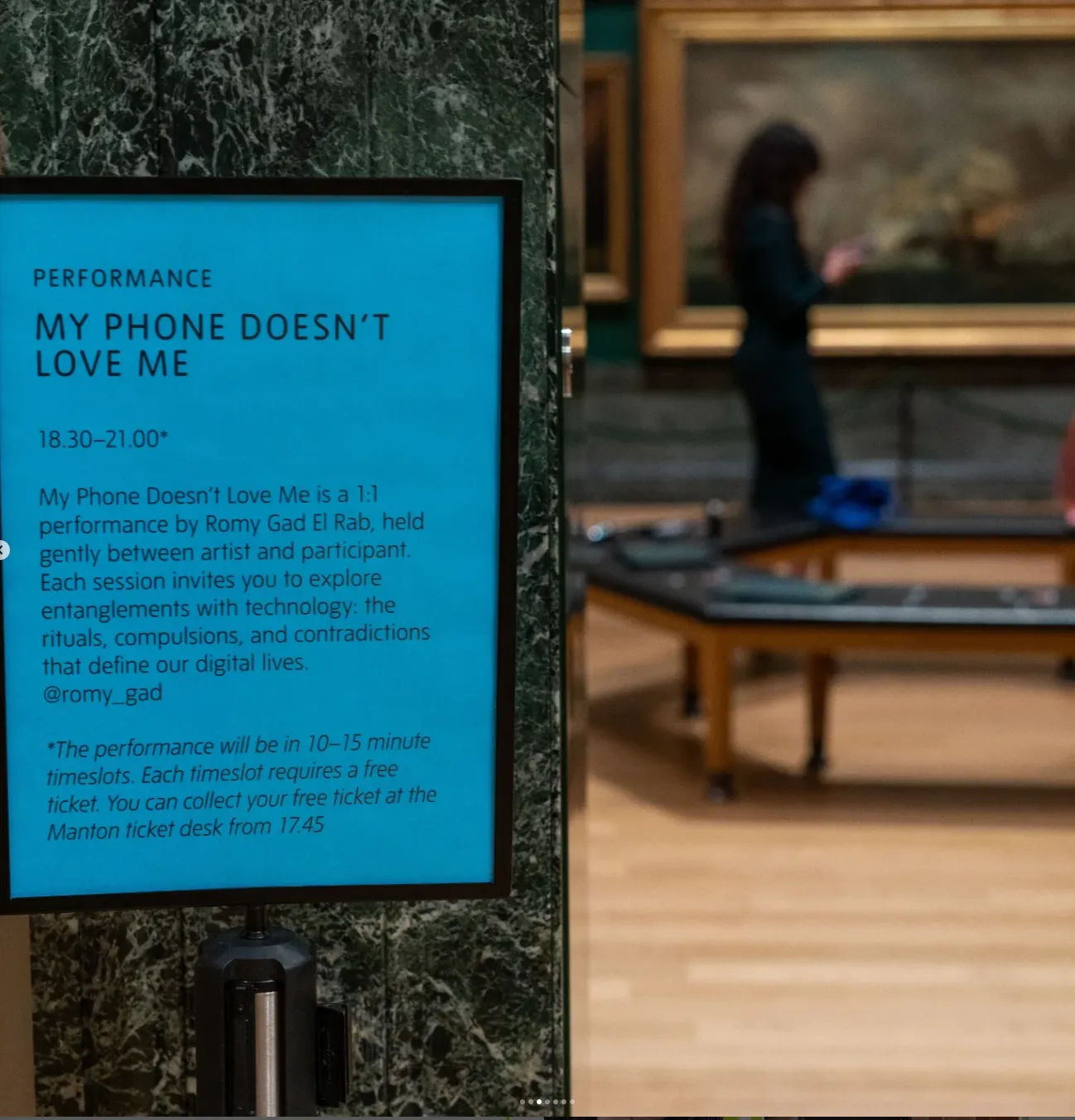
My phone doesn’t love me (2025) was a performance staged by Dr. Romy Gad el Rab at Tate Britain in 2025 in an evening curated by HERVISIONS. Visitors interested to take part were instructed to book an appointment lasting up to 15 minutes before being directed to a gallery that had been transformed into Romy’s consultation room for the evening. Then they enter — sometimes solo, sometimes in pairs — and take a seat. Some people share personal, sometimes intimate, recollections about how they live with their phones. Others are less willing to open up. Regardless of whatever is said or left unsaid, each visitor is offered a handwritten prescription, described by Romy as “part placebo, part provocation, part poetic directive for life after the interface.”
Booking a consultation with a psychiatrist in an art gallery may not be the time or place we expect to reflect on the desires, compulsions, fantasies or anxieties we may have towards our smartphones — devices many of us would feel unable to live without.
I interviewed Romy at the end of May, because I wanted to understand how she developed the concept for this event and why she is so keen for her practice to migrate from the academic journal page to gallery spaces. I asked Romy about her route from psychiatry to art, and why she feels galleries are such important settings for starting discussions about our relationship with technology.
To begin, Romy explained her thinking behind my phone doesn’t love me:
Michael: The thing about psychiatry — and I think it’s true for a lot of people — is that mental illness seems scary. Doctors, clinicians, and the language around psychiatry can be intimidating, but you’re communicating your thinking and practice of treating mental illness through art. What struck me about my phone doesn’t love me is how you are subverting the doctor-patient clinical setting. Was that your intention?
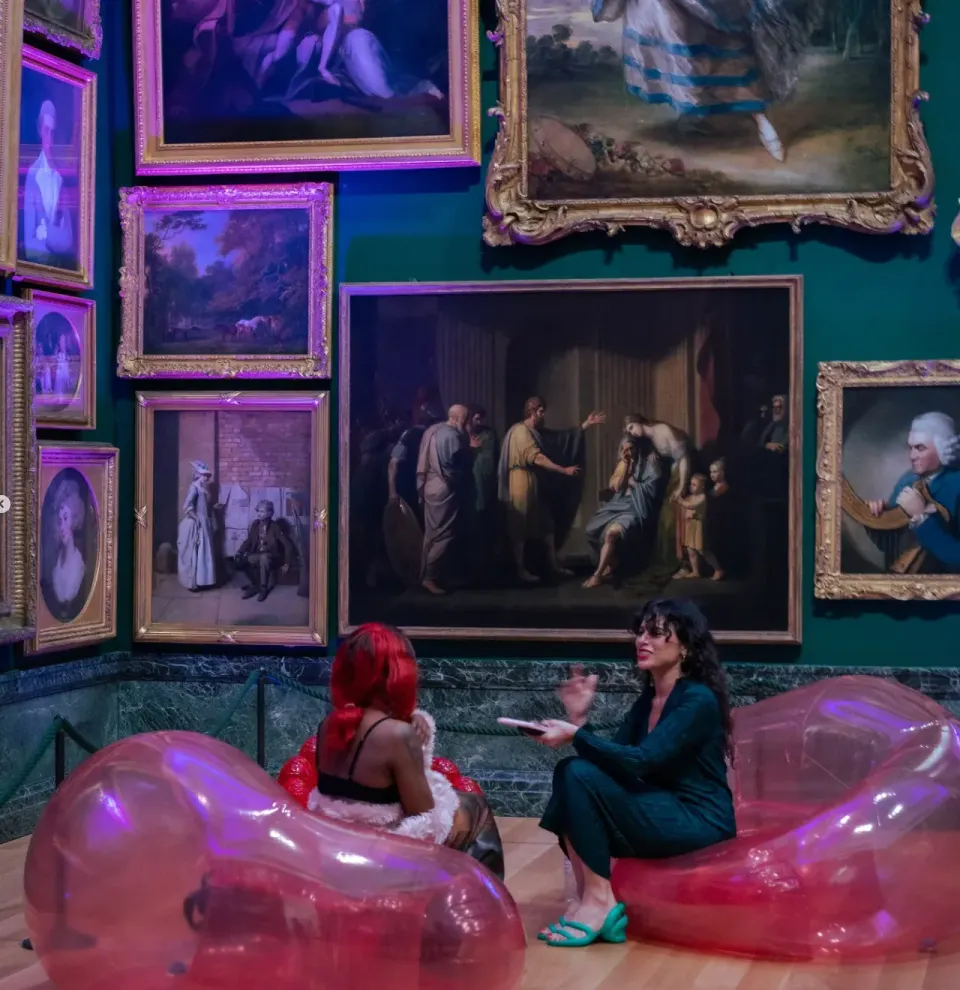
Romy: Totally! So Zaiba Jabbar the incredible founder of HERVISIONS — a femme-focused platform for digital artists — invited me to take part in this evening ‘Digital Intimacies’. I was so grateful. She said ‘Choose the room you think is best’, so I went around the gallery and chose this small square room covered from ceiling to floor in old paintings with opulent gold frames. I wanted it to be the most opposite setting to your typical NHS consultation room.
Michael: And even the smell!
Romy: Exactly, and the seats! For our Tate evening, I ordered these big pink blow-up chairs. I liked the absurdity of them in this setting, so people would feel comfortable engaging with a process that might normally be scary. Psychiatry has a challenging history and still has a lot of baked-in biases. Psychiatry more than psychology is about treating mental health so it’s serious — and so it should be — because we’re trying to treat people who are really suffering. I really enjoyed being able to engage with this kind of therapeutic relationship in an art space. I was surprised with how people responded to it. Some people came in, sat in the chairs, and told me really intimate things and were crying. And some came in and sat there like ‘I don’t really have a relationship with my phone. It’s an object isn’t it.’
The immersive digital worlds we inhabit combined with the computational capability for social media networks to serve a limitless supply of content — more recently aided by generative AI technology — has changed the way we live with networked technologies. In our conversation, Romy told me about Digital Hyperconnectivity and the Self (2020) — a paper by Professor of Sociology at UCLA, Rogers Brubaker — that greatly influences her practice. In the paper, Brubaker argues that the digitally mediated actions we take across the many networked environments we use — whose traces are digitally stitched together by both the host technology companies and the data brokers trading in amassing complex profiles of people’s behaviours online — are “…intrinsically objectifying. Every text, every email, every click of our browsing history, every app-mediated action, every sensor-recorded data point, every action and interaction on social media, even the most trivial ‘like’ or retweet, leaves digital residues, many of which persist as digital objects.”
Digital hyperconnectivity wraps us in predictive and immersive computational worlds efficiently optimised to engender our continued engagement. We are helplessly attached to devices honed for our continued compulsive engagement in algorithmically generated content worlds where intentional choice is fast being optimised out of our modes of interaction.
We may have never considered how we developed such symbiotic dependencies on devices playing host to hundreds of apps that have been deliberately designed to keep us picking it up again and again and again and again.
By bringing the clinic into a public space, Romy is using embodied learning to gently invite her visitors to reflect on the messiness and contradictions of these devices that can be a source of joy, comfort and companionship, yet are equally extractive and surveillant — both of their users plus the digital and labour chains that brings them into our possession.
My phone doesn’t love me asks us to confront the long-term implications of being continuously stimulated by networked digital technologies and what that might be doing to our ability to think creatively.
About Romy’s practice
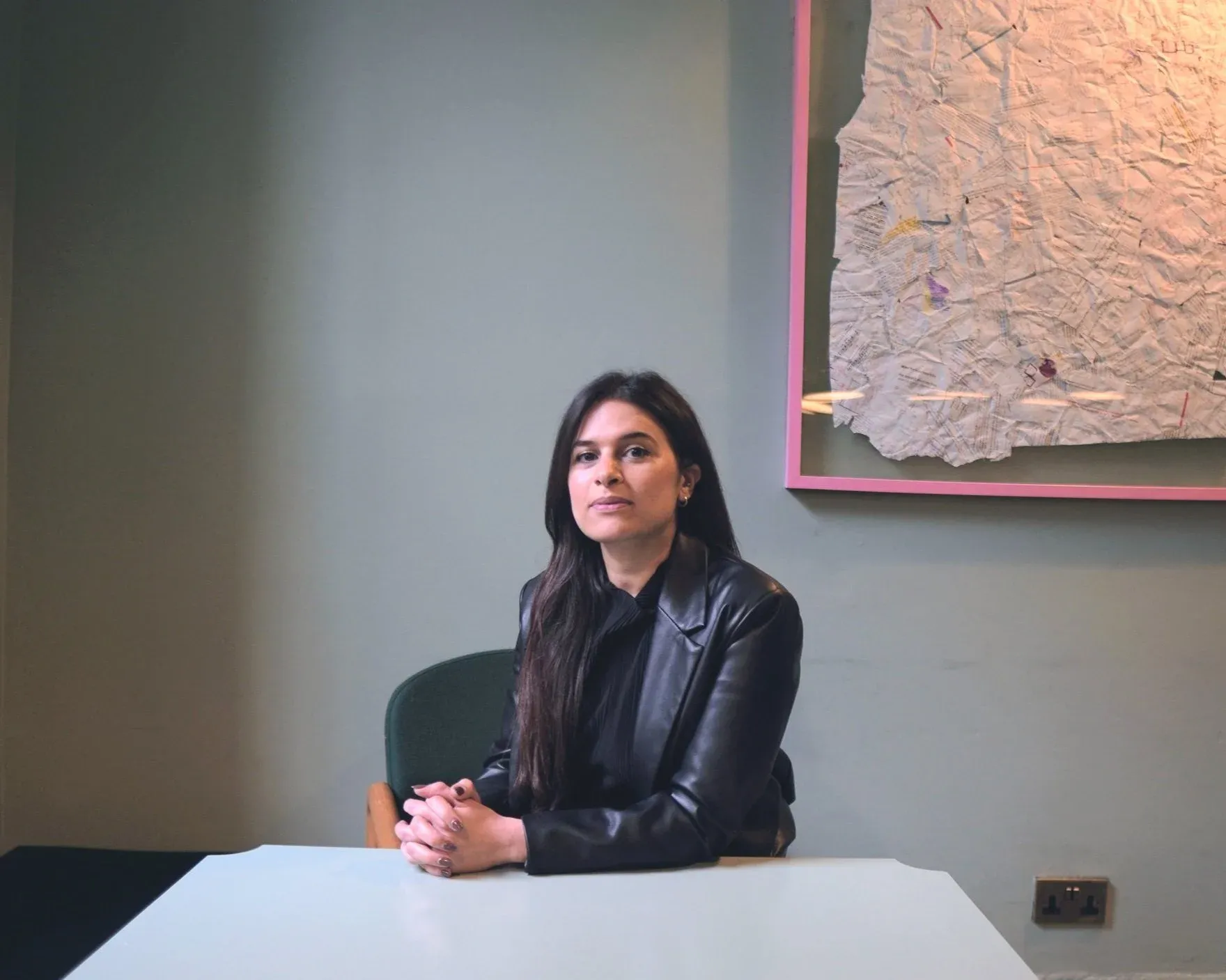
“Art has this way of making your inner feelings public and getting an audience to critically engage with subjects [like technology addiction] beyond reading an article or scientific journal... I’ve always felt my practice is like making a public health intervention, so instead of reacting to a poster — let’s say one with an anti-smoking message — I prefer to make people feel something through an artwork, a workshop, or a performance that challenges them to examine their habits. This becomes a meaningful way to communicate my message.” — Dr. Romy Gad el Rab interviewed by Michael Kibedi for First and Fifteenth, 30 May 2026
The origin of my phone doesn’t love me can be traced back to Romy’s joint residency at the Delfina Foundation with fellow artist-researcher Caroline Sinders in London during 2025. Each year Delfina Foundation funds places in their evolving critical thematic programme for between six to eight artists, curators, researchers and writers from around the world to live and work in their London townhouse and develop their practice — Romy and Caroline’s work was part of the third season of SCIENCE_TECHNOLOGY_SOCIETY.
I wanted to delve into Romy’s critical stance, because so much of her investigative work on the problematic uses of technology directs our critical attention away from the individual (important as that may be) to target the technology companies that design, optimise, and continue to profit from the extractive status quo:
Michael: When I first came across your work, I was struck by your willingness to confront power. A lot of tech events I go to have speakers suggesting solutions which almost always involve adding more technology. There’s loads of apps — I forget the names — that limit your social media use. The tech industry’s answer is, ‘You’ve got this problem with using social media and so we give you another app to help control that.’
Romy: Yes, they are like sticking plasters. I mean, they can help and I would tell people to download some of these apps, because ultimately if they are designed to be addictive, we need to find ways to add friction. But, equally I find it absurd that a tech wellness industry exists. Tech is messing with us and the same industry pushes us to spend thousands to solve it. The fact that Brick [1] has gained so much popularity, I understand it, but I also see an absurdity in it.
Michael: Yep, ‘Here’s a problem we created but we will sell you a solution as well’.
Romy: Exactly! The tech bros create a problem, then the tech bros create a solution.
Michael: But the thing is, technology addiction isn’t new. I was thinking about this when I was getting ready for our chat. Do you remember how the BlackBerry was nicknamed The CrackBerry? I think it was when Barack Obama was first elected. He didn’t want to have his BlackBerry taken [for security reasons] by the Secret Service. But for me, when I was a teenager, the things I used a lot or struggled to control were things like MSN Messenger.
Romy: Yeah! If my dad was on the telephone when we used dial-up and [me and my friends] we were all going to meet up on MSN Messenger, I’d be fuming if my uncle called or something! The technology had that pull. I think I’m looking back at it nostalgically or romantically now; but for me there was some sort of genuine connection and community at that time. It was like, ‘Okay, this is new technology and I’m going to talk to my cousin in Egypt’. Before we had WhatsApp, we were able to communicate and meet people. It was exciting. Social media has moved so far away from being social, we’re consuming algorithmically-driven or — and I know you and I love a bit of AI slop![2] — even, algorithmically-created content. I still like social media’s benefits. There are many friends — like me and you — that made contact through it. I’ve made friends fully through social media, from online events and meet-ups.
Michael: I’m forever aware that the algorithm is this thing in the middle we don’t quite know how to control. Why has the algorithm shown me this person’s content on this day at this time while I’m in this mood? Most people in these tech companies don’t know how these algorithms work. It’s also funny that I come across different versions of the same post every couple of weeks where someone tells you how to beat the algorithm — ‘This is the way you get your post seen: you use these hashtags or structure the post this way’; or the whole thing with LinkedIn that you have put the link in the comments to fool the algorithm — it’s tech folklore! But do you think our tech addiction problem — I know you weren’t studying at an academic level in the days of MSN Messenger or BlackBerry — but do you think tech addiction has got worse with these new technologies or is it just our perception?
Romy: I think it’s definitely got worse, purely because of access. There was someone I was talking to recently and they felt nostalgic for ‘The Computer Room’ — [it might have been somewhere] in your house, your dad’s office, or some room you had to go to and log in and then leave. We all have this appendage constantly in our hand — and many people write about this — that [this object] has got something infinitely more exciting than whatever is around us in that moment that we feel drawn to it. It just makes the problem worse — like having a flask of whisky attached to your hip — it’s just like constantly there and very hard to resist.
Mental health conditions are very far from fixed categories — a topic critically explored in Mad World: The Politics of Mental Health (2024) by Micha Frazer-Carroll[3], a book both Romy and I have read. Despite mental health conditions being framed as dispassionate definitions wielded by a profession operating through a structurally imbalanced power dynamic, they are too often diagnosed through racial, cultural, and gender biases. Black people experiencing mental distress in the UK are often perceived as violent rather than vulnerable before ending up disproportionately detained, over-diagnosed and over-medicated — particularly for conditions requiring antipsychotics — while ADHD is persistently under recognised in women because so many of its clinically recognisable traits are derived from behaviours presenting by men.
The boundaries defining a mental health condition are continually in motion — a tension that Romy grapples with. The structural and clinical implications of how her clinic would cope if these boundaries around problematic technology use were to change is at the forefront of her future concern:
“When I talk to other researchers, the terminology we use is ‘problematic internet use’ which includes other technologies, not just social media. It could be online shopping, pornography, all sorts of things — actually pornography is a bit more complicated — but problematic internet use is getting more and more research into it. At some point, it may be included in the Diagnostic Manual (DSM)[4]. I’m not against that because there’s already people living with problematic internet use and there’s nowhere for them to get help, so unless we can diagnose it, there are no services available. But on the other hand, if we make every [mental health issue] a medical condition, it’s puts the onus on you [as an individual] instead of critiquing the technology companies that are creating this situation… The bigger question is the design of social media products. Meta was recently in court for this. If they knew [their products were] designed to be addictive, why is that on the individual [to fix]? That’s why I want to critique Big Tech. I want to help people with technology addiction, because these are real problems they’re facing.” — Dr. Romy Gad el Rab interviewed by Michael Kibedi for First and Fifteenth, 30 May 2026
What’s next?
Romy continues to develop her art and research practice, so what’s next?
In defence of boredom
For someone so interested in the extremes of technology use and addiction, one of Romy’s current research interests is in a seemingly distant mental state:
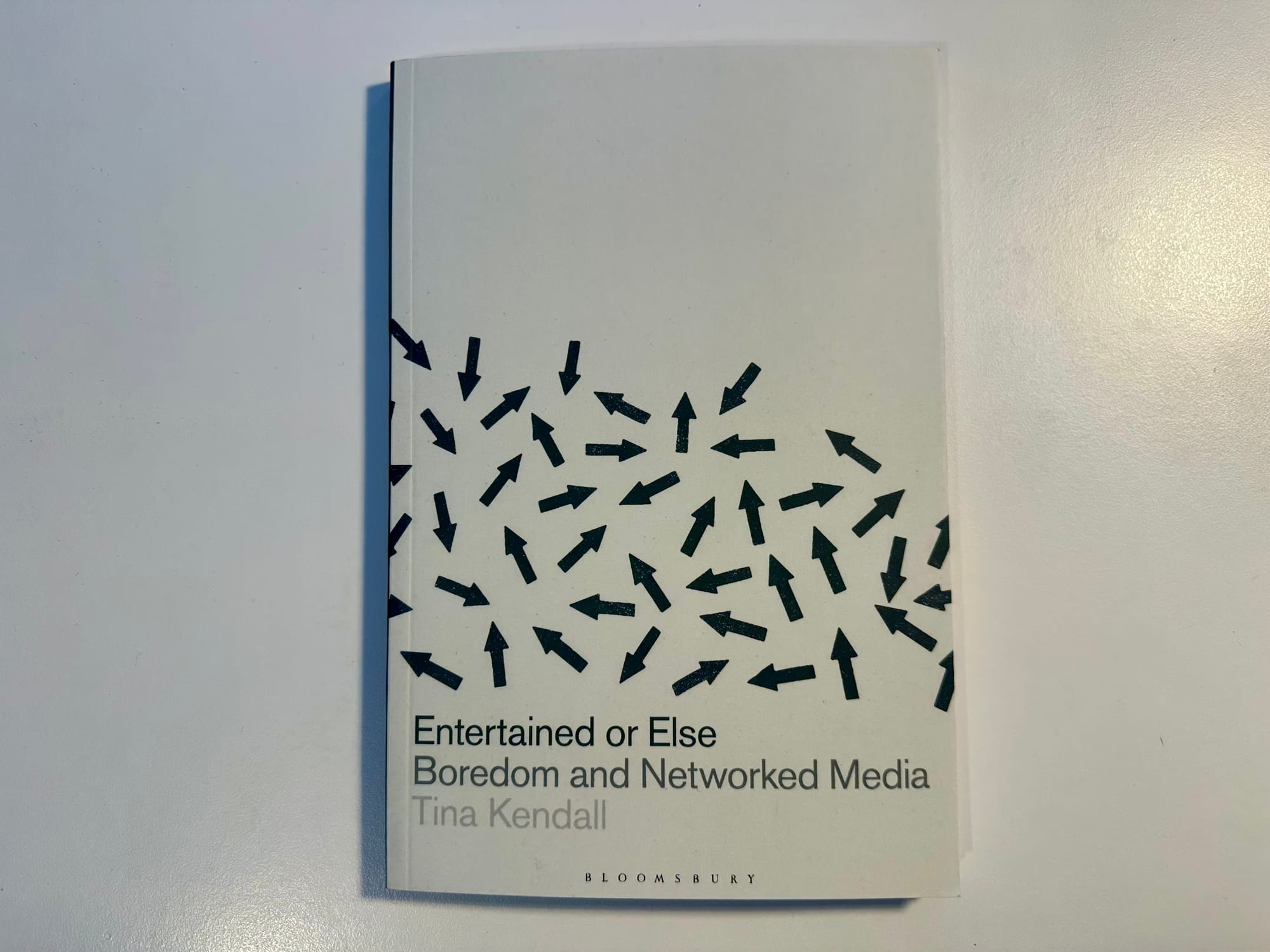
Romy: Boredom is something I’m super interested in at the moment. I’m trying to explore this idea more. I recently read Entertained or Else: Boredom and Networked Media by Tina Kendall[5] where she likens social media to a pacifier for the boredom we experience — the idea that it’s wrong or intolerable to be bored, that we can’t sit with it. Jonathan Crary’s 24/7: Late Capitalism and the Ends of Sleep was one of the first books I read that explores this and it stayed with me; he had some sentence about [this kind of boredom] too. Back in the day you would have to sit at a bus stop and tolerate not knowing when a bus was coming. It’s a bit frustrating, yes, but you would have a little daydream, you would look at the person next to you, have a thought or something. I do think this [constant technological stimulation] erodes our creativity, I really believe that.
Romy: I’ve been looking at this area of the brain called the default mode network. It’s a series of brain connections that are only active when our minds are wandering and when we’re in active rest — not when we’re sleeping, not when we’re doing a task, it’s when we’re in those in-between moments. In our day-to-day there are lots of moments we go into that. You’re on this call with me right now and you can be thinking about something that happened yesterday. It’s not that boredom has completely eroded, but I think if we are constantly consuming, constantly doing some sort of task on our phones, we leave fewer moments for the default mode network to connect. And those areas of our brain are really important for self-referential thoughts — when we think about ourselves or others, recall memory, or think about the future — you need all those areas to connect so we can come up with new ideas and be creative. If we’re blocking access to those in-between moments constantly, I believe that has an impact on our creativity.
Michael: Isn’t it fascinating that the tech industry has created this [over-stimulation] problem and has now come up with a solution? One of the first things that got people so excited when ChatGPT came out was that it was so easy to ask for five ideas for a story and it would just give you those ideas straight away. It’s as if we’ve been pushed into this state of always being overstimulated and have begun to lose our creativity. Now here’s this new thing that says, ‘Oh, we can suggest and now even build these ideas for you’ — and the results look so bland and samey.
Romy: They do look bland, but I’m not against cognitive outsourcing. Like, if I give ChatGPT something boring I don’t want to do — cool; there’s this paper called Thinking—Fast, Slow, and Artificial: How AI is Reshaping Human Reasoning and the Rise of Cognitive Surrender by Steven D. Shaw and Gideon Nave. The term ‘cognitive surrender’ is interesting and different— when we surrender things to ChatGPT and not question the validity of it, I think that is concerning.
Michael: There’s also an element of automation bias too — the fact that if it’s a machine that’s made this thing, we view it as more trustworthy because it’s a computer and the computer is always right.
We find ourselves reduced to passive consumption in algorithmically shaped digital worlds. Surfing has become scrolling — even our modes of online exploration are constricted to being guided along on invisible rails. The constant supply and expectation to consume novelty means we have little space to let our minds wander. Tina Kendall writing in Entertained or Else: Boredom and Networked Media (2025) calls this a state of “compulsory continuous connectedness” (pg. 15) and the expansive appetite for our networked digital worlds to optimise any and every mental state for continued engagement means that even our boredom is now repurposed to be a communicable performance.
Focal Point
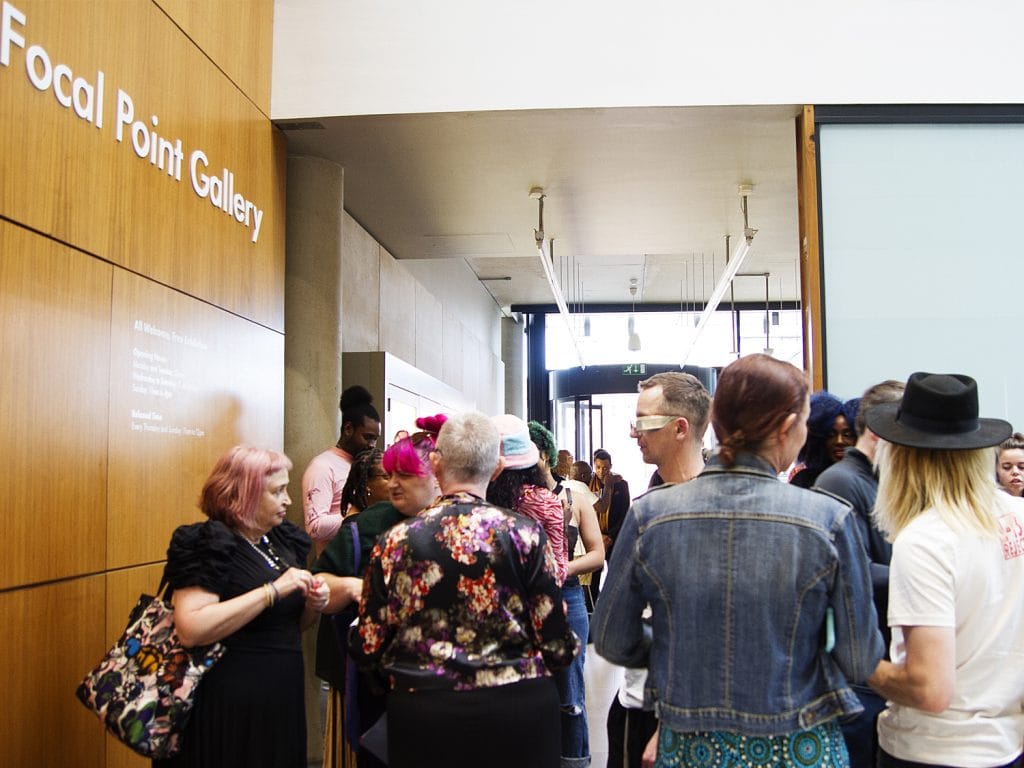
Romy’s next exhibition with her collaborative partner Caroline Sinders opens at the end of September at Focal Point Gallery in Southend-on-Sea in Essex. In our conversation, Romy vividly described their vision for this work:
Romy: Art shows are often London-centric, so I’m so excited to do something in Essex. My childhood was spent going to see family there, so it’s very happy for me to return. Our co-curated group show explores our entanglements with technology. We have four other invited artists and we’re showing work that looks into ideas around labour, surveillance, and the presentation of the body online, and other subjects that concern loneliness, but through quite physical works. There’s not a lot of screens for an exhibition that’s going to be about the digital, which is intentional. We’re also planning a symposium and performances by other artists as well.
Romy: In our piece, we’re making a new work about the default mode network I’ve been talking to you about. We want to examine the kind of spaces we let our minds wander — using this as a counter narrative to the constant consumption of technology and the impact the algorithm is having on us.
Romy: Lots of people are feel constantly feeling burned out, so our space will be softly carpeted — it will be an invitation to experience stillness with no phones in that room. It’s not about taking photos or putting them on social media. It’s about being as present as a counter narrative to the hyper-connectivity we experience.
Romy’s next exhibition promises to deepen the dialogue we engage in to explore our entangled existence with digital technology. When I named this piece On algorithmically aggravated addiction — aside from its pleasing alliterative quality — I wanted the title to function as an alert. We exist in digital worlds calculatively structuring our online worlds into portals of never-ending content that serve to reduce us to passive subjects operating under the impression of possessing agency, but in reality compulsively reacting to content cynically optimised to keep us scrolling.
Daisy Fancourt writing in Art Cure: The Science of How the Arts Transform Our Health (2026) observes that “by experiencing negative emotions in art, we're able to contemplate our own responses and practise how to manage them” (pg. 64). When artist-researchers like Romy and Caroline use art as delivery medium in spaces absent of screens, they are affording us spaces to reflect on our emotional interior and how facets of our being — our creativity, reflexivity, and critical thinking — are being flattened under the weight of algorithmic feeds that give us no space to momentarily breathe. We can use the little agency we have left to assert our determination and refuse the narrow algorithmic worlds that threaten to keep us captive on their invisible rails.
Brick is a screentime control device and app for smartphone, which limits access to apps chosen by the user. What makes it different from existing screentime limiting software, is that the smartphone has to be physically tapped on the Brick device (using NFC technology) creating a physical access control to activate or deactivate the block. ↩︎
Romy and I were conference buddies last December at the fantastically named Brain Rot, AI Slop, and the Enshittification of the Internet at Anglia Russia University, Cambridge, where we also met Tina Kendall, Associate Professor of Film and Media, at their book launch Entertained or Else: Boredom and Networked Media. My essay, Fifteenth #18: On the slopcore aesthetic is partly a response to many of the papers presented that day and my attempt to theorise the cultures surrounding algorithmically generated content. ↩︎
Micha was also a Delfina Foundation resident at the same time as Romy, in 2025. ↩︎
The Diagnostic and Statistical Manual of Mental Disorders, commonly known as the DSM, is an internationally accepted manual of clinically recognised mental disorders published by the American Psychological Association. The DSM is influential in psychiatry and drug research, guiding clinicians in diagnosing mental health disorders. Critics argue that the classifications of some disorders are shaped by cultural biases and cater for wider attitudes towards what society deems (ab)normal while its expanding scope can be seen as a desire to over medicalise human distress or trauma — some may say for the ongoing benefit of pharmaceutical companies. ↩︎
Tina Kendall, citing Ludmila Lupinacci, writes in Entertained or Else, that “… boredom’s more weighty existential dimensions are also downgraded in this context, so that it can instead serve as a prompt for what Ludmila Lupinacci calls ‘compulsory continuous connectedness’: a pervasive and socio-technically constructed notion that it is only by keeping always-on ... and actively engaged that one can navigate and thrive in an environment that is purposefully framed as continuously uncertain. In this context, boredom is imagined as a problem, but a trivial one, which can easily be managed through compulsory continuous connectedness.” (pg. 4) ↩︎
About Romy Gad el Rab
🌟 Dr. Romayne (Romy) Gad el Rab (FRCPsych) is a psychiatrist, researcher and artist who explores our intimate entanglements with technology. Romy was the founding co-chair of the Royal College of Psychiatrists Digital Special Interest Group and is currently an honorary psychiatrist at the UK National Health Service (NHS) National Centre for Gaming Disorder, a public funded service treating those with gaming disorder — the only clinically recognised category of disordered technology use in the UK.
Romy’s most recent artwork, in collaboration with Caroline Sinders, is part of AI and the Paradox of Agency on show at Bildmuseet in Umeå University Sweden until January 2027. In London, Romy’s work has featured in programming at Tate, Somerset House, and Delfina Foundation, and she has spoken at The Serpentine. Romy’s next exhibition opens at Focal Point Gallery in Southend-on-Sea at the end of September.
A published academic and curator, Romy’s practice creates spaces where science, technology, and art meet through conversation, research, and making — combining clinical insight with interactive installation and performance to question digital addiction and the power structures behind networked systems.
Thank you 🖤
🫂 My thanks to Romy for her participation while juggling a busy clinical schedule. Despite my name appearing at the top and bottom of this page, the resulting text you have just read is a piece that Romy and I have collaboratively developed in conversations spanning many months. Unless otherwise stated, the photos in this essay have been provided by, and used with permission of, Romy Gad el Rab.
Disclosure
I have not been paid nor have I received any other benefit to write this article from any of the institutions, organisations, or individuals named in this piece. Non-attributed opinions or reflections expressed in this essay are my own. Any mistakes are my own.
Watch
Listen
 Pocket Casts
If Books Could Kill, 8 August 2024, 2 hours
Pocket Casts
Ten Thousand Posts, 9 August 2024, 1 hour 12 mins (9 min preview)
Pocket Casts
Illuminated, 1 September 2024, 26 mins
Pocket Casts
Disintegrator, 22 December 2025, 51 mins
Pocket Casts
FT Tech Tonic, 18 February 2026, 35 mins
Pocket Casts
Tech Won’t Save Us, 9 April 2026, 1 hour 2 mins
Pocket Casts
The Data Fix, 13 April 2026, 1 hour 9 mins
Pocket Casts
The Blindboy Podcast, 29 April 2026, 1 hour 48 mins
Pocket Casts
Illuminated, 2 June 2026, 1 hour
Transcripts are available for Artificial intimacy: The delusion machine and Attention.
Further reading
Recommended by Romy:
- Psychopolitics: Neoliberalism and New Technologies of Power by Byung-Chul Han, translated by Erik Butler (Verso Books, 2017, 96 pages)
- Digital hyperconnectivity and the self by Rogers Brubaker (Theory and Society, 2020, vol. 49, pages 771-801)
- “Digitized Dysmorphia” of the female body: the re/disfigurement of the image by Isabelle Coy-Dibley (Palgrave Communications 2, Article no. 16040, 2016)
Our joint recommendations:
- Mad World: The Politics of Mental Health by Micha Frazer-Carroll (Pluto Press, 2023, 182 pages)
- The Dark Forest Theory of the Internet by Bognia Konior (Polity Books, 2025, 138 pages)
- Entertained or Else: Boredom and Networked Media by Tina Kendall (Bloomsbury Academic, 2025, 165 pages)
- Exploratory study of Addicting Design by Caroline Sinders and Romayne Gad el Rab (Convocation Research + Design, 2026)
Recommended by me:
- The Psychopath Test: A Journey Through the Madness Industry by Jon Ronson (Picador, 2011, 320 pages)
- Are You a Software Update? Reader edited by Nora O’ Murchú and Janez F. Janša (Aksioma, 2025, 191 pages)
- Technocreep and the Politics of Things not Seen edited by Neda Atanasoski and Nassim Parvin (Duke University Press, 2025, 300 pages)
- Searches: Selfhood in the Digital Age by Vauhini Vara (Grove Press UK, 2025, 334 pages)
- Art Cure: The Science of How the Arts Transform Our Health by Daisy Fancourt (Cornerstone Press, 2026, 352 pages)
- Love Machines: How Artificial Intelligence Is Transforming Our Relationships by James Muldoon (Faber & Faber, 2026, 266 pages)
- When AI Feels You Deeply by Monika Jiang (The Oneliness Project, 2026)
And finally...
☀️ That’s a wrap for my 2026 cycle of First and Fifteenth. I have a few other ideas gently simmering, so I may surprise you with another newsletter or two later in the year. Then again, I might not. Either way, enjoy your summer. First and Fifteenth #21 returns on 1 March 2027.
💌 If you liked reading about Romy’s work, you might enjoy this essay I wrote about another former Delfina Foundation resident. Meshwork by Merve Mepa is a profile I wrote on my old newsletter platform about the Istanbul-based conceptual artist and researcher Merve Mepa, whose work has since been shown at the 18th Istanbul Biennale in 2025.
🎙️ Today (15 July), I am speaking at the Ecological Citizen(s) Festival held at the Museum of Making in Derby. This is a free one-day event attended by over 100 multidisciplinary guests including academics, artists, musicians, activists, ecologists, citizens scientists, VCSE workers and volunteers, community members, entrepreneurs, conservationists and more!
🇦🇹 I will be speaking on day 1 of uxcon vienna (16-17 September). My talk is called Whose English gets to be default? and is about accent bias and speech recognition. Tickets available now. Use my personal code MICHAELUXCON to get 10% off!
📣 I have a chapter in the forthcoming essay collection Digital Design for Planetary Care: The Hidden Environmental Cost of the Digital World co-edited by Professors Elio Caccavale and Gordon Hush. The book will be published by Bloomsbury Visual Arts in summer 2027.
💳 If you like what you have read, please consider supporting my independent practice with a one-off £10 donation. That will be a welcome contribution towards the ongoing costs of keep this website running!
📚 You can buy books mentioned in this newsletter from my page on Bookshop.org (affiliate link)
🗄️ Editions #1–15 of First & Fifteenth were published from 2023 until 2025.