First #17: Research for People Who Think They Would Rather Create
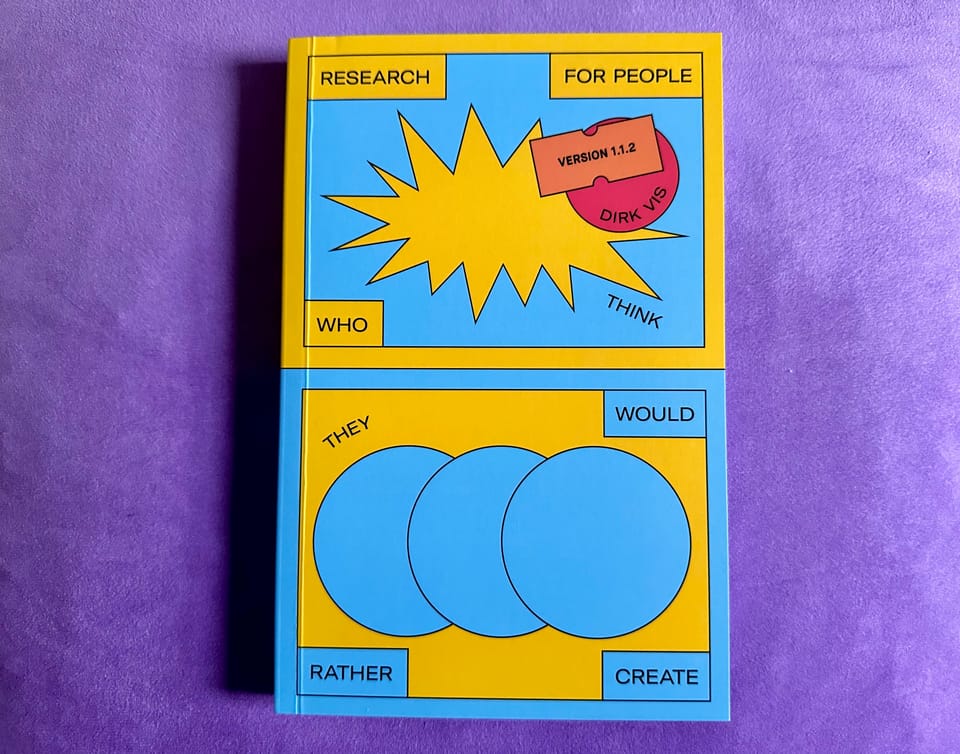
Research for People Who Think They Would Rather Create is a slender manual written by Dirk Vis — a Dutch lecturer at Willem de Kooning Academy Rotterdam and the Royal Academy of Art in The Hague — whose work spans fiction, essays, and poetry.
Despite the book’s pleasing tactility and aesthetic, Research for People is not to be mistaken for a decorative object, but rather it is a volume to be used, discussed, and annotated. Vis urges us to “… skip [the] introduction if you immediately want to start learning more developing your own artistic research document” (pg. 6).
My design research projects often start by asking a critical question about how we use or interact with technology. The approaches and methods used by academics, artists, and design researchers have been converging for many years — with practitioners borrowing from each other and presenting their work in forums with fewer barriers between industry and academia.
Perhaps due to the convergence of software we use, or the interdisciplinary nature of investigative design research — technologists increasingly converse with sociologists, artists grapple with complex datasets — we find that the ways we communicate our thinking has necessitated a disruption of convention surrounding the artefacts we produce. As Vis observes:
“... we can consider research, in the context of art, as embracing a broad range of methodologies and combining different forms of knowing.” — Research for People Who Think They Would Rather Create, pg. 6
For people doing research academically or professionally, Research for People traces the structure of a typical research-led project, so its ordering will feel immediately familiar. We are taken from requirements and research question definition, through process and method, to how might gather then publish findings.
Books demand linearity in how we read, but that is far from the author’s intention. We are urged to open the book at any page and navigate it in whatever order piques our interest or responds to our situation.
“The broader point here is that, regardless of the origin, shape or form of the research document — for instance a mural — a viewer should be able to find a way to demonstrate that your research might be incomplete or mistaken. This should also be true even if you are using a wide variety of forms of knowing. If this is not the case, then what you are doing is not traceable, and it will not be of any use in communicating your findings to others.” — Research for People Who Think They Would Rather Create, pg. 19
In Vis’ reckoning, a research document is normally a written document, although he appreciates it may take on any form or medium. In academic and professional settings, researchers must often adhere to a pre-defined structure to meet externally imposed criteria — against which, researchers have little agency to deviate. The research document is a vehicle for tracing the researcher’s thinking as they grapple with the question they investigate — communicating their findings to a wider audience in a way that “stems from the practice” (pg. 21); this means the resulting output may not necessarily be a document in the way we traditionally interpret the word.
In the spirit of the research document so vividly presented by Vis in Research for People, I am discarding the predictable convention of the book review to reflect on two practitioners that communicate, subvert, and stretch the boundaries of the fields they inhabit.
X-Ray Portraits (2013)
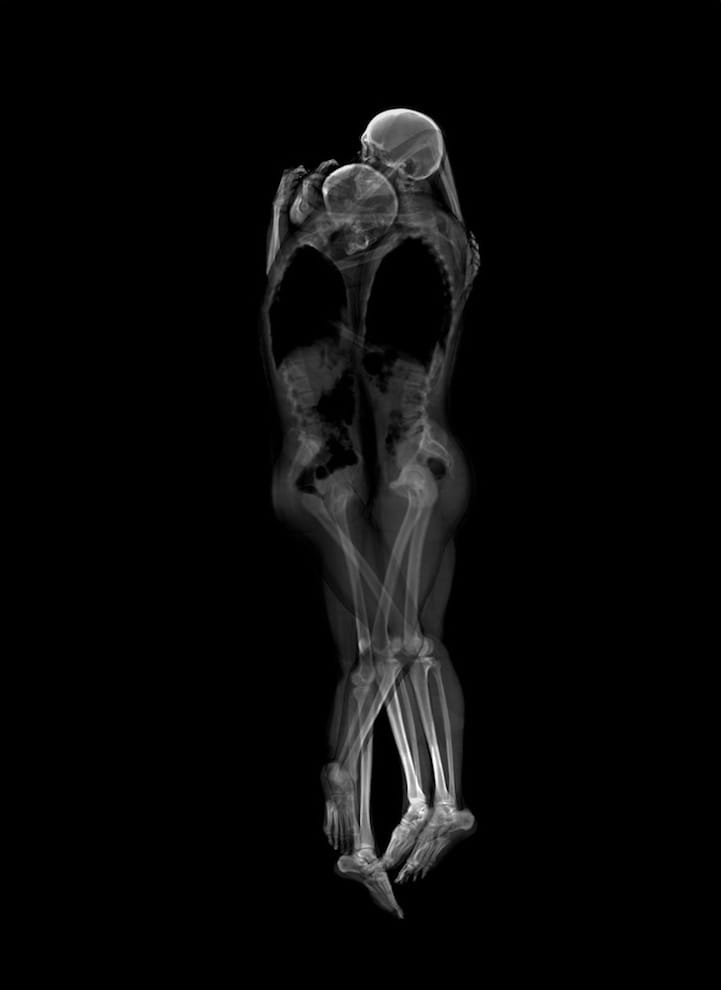
X-Ray Portraits (2013) was one of the most arresting images that lingered longer after my first encounter with Research for People (pg. 48). The original series of photos resulted from a collaboration between Saiko Kanda and Mayuka Hayashi — two Japanese photographers who worked alongside the medical technicians operating the machines.
In the series, the Kanda and Hayashi produced a series of visual research documents that are both provocative and subversive: Provocative, because of our instinctive reaction to the sight of human bones or skeletons — redolent of death, reminders of our mortality. Subversive, because equipment normally we associate with detecting injury or malignant growth have been appropriated to capture portraits of couples celebrating intimate expressions of love and vitality.
X-Ray Portraits stayed with me long after I first finished Research for People — eventually becoming an emblem and thematic muse of Death, and how tech forgot about mortality, a talk I wrote in 2024 about online existence and the material fragility of technology.
Vis tells us that X-Ray Portraits was included in Research for People to remind us that we often have to develop relationships with collaborators outside of our field who may not share our disciplinary outlook — yet it is through such professional mismatches that unique and valuable outcomes can be realised. The images remind us that art and design research is rarely a solo endeavour.
BLKNWS: Terms & Conditions (2025)
BLKNWS: Terms & Conditions (2025) is a resonant example of a research document described by Research for People (albeit one too late to be included for publication), showing itself to be a film full of contradictions, provocations, and ruptures that has taken up a lot of my thinking during my repeated viewings since I first saw it in December 2025.
BLKNWS began its gestation in 2017 when its director, Kahlil Joseph, watched The Black Outdoors, a 2009 talk called between the writer Saidiya Hartman and cultural theorist Fred Moten, before being developed into a video art installation for LA’s Underground Museum and other gallery spaces around the world.
BLKNWS asks its audience to treat it as an album. Repeated viewing clarifies its seemingly disconnected scenes as part of a set of narrative tracks pulsing throughout its two hour runtime. Time is elastic in BLKNWS, as it portrays vignettes of Black history, Black futures, and the ease with which Bleak creativity traverses these seemingly distant plains.
As much as it is expansive and global in scope, BLKNWS is also a deeply personal film — telling the story of Joseph’s relationship with his parents and both sets of grandparents. Repeated viewing has left me reflecting on how the search for home are central to its many stories — of the migration undertaken by his grandparents from Brazil and across America; of W.E.B. Du Bois and Lois, his wife, settling in a newly independent Ghana in the twilight of their lives before discovering he had been effectively exiled by the American government; of the precarity of Sarah and Lady’s tenure that the young Du Bois slowly unravels during the fictionalised reimagining of his Philadelphia survey of Negro life; of the Benin mask looted during the colonial era — imprisoned far from its home; of the voyage to a new home in Ghana that the passengers of the Nautica undertake in the film’s near-future fiction; of the temporary refuge the Nautica offers to migrants rescued from the ocean along the way.
BLKNWS is also a film about inheritance — of a passion for art and Black history passed down by Joseph’s parents (his brother was the late Noah Davis) — and the inherited trauma that follows In The Wake of those of us burdened with a diasporic existence. There is a sense of perpetual motion — perhaps a gesture to the futility of trying to diminish Blackness into a fixed category that is subject to the vagaries of timebound taste and fashion.
From the near future tale of Shalya, the journalist travelling on the Nautica, to the ruptures of Joseph’s familial migration across America — nothing and nobody quite belongs in the places they find themselves situated.
When Du Bois’ data visualisations flashed up on screen, I was reminded of the essay I wrote in 2024 on data gaps which drew heavily on the pioneering counterdata work exhibited by W.E.B Du Bois and his team at the 1909 Paris Expo, which Joseph uses as a past and future narrative arc, while also using its visuals to punctuate the film at regular intervals.
References come thick and fast in BLKNWS. From its opening sequence — across archive newsreels and personal home videos, to memetic Instagram and TikTok reels — BLKNWS pays testament to the way we flit through these media in an emulation of how he first thumbed his way through the pages of encyclopedia Africana — W.E.B Du Bois’ grand project he never saw finished in his lifetime.
The non-linear structure is a reminder of the ways in which the archive poorly serves as a lens to inquire into Black life or a vessel to capture its essence; and that despite the richness of our stories, there is an inherent patriarchy which enacts erasure as we learn of the gaps around Funmilayo Ransome-Kuti’s role in the campaign for Nigeria’s independence. As Fred Moten comments:
“… one continually confronts the necessity of supplementing the historical record which is often not just incomplete, but repressive. The record is replete with all these words that don’t correspond to the situation.” — Fred Moten BLKNWS at 18:54
For the design researcher interested in telling stories of Black life — past, present, and futures — we are reminded that the rigidity of Western storytelling is ill-suited for capturing the narrative essence of Blackness. Like its intermittent techno soundtrack — at first, out of place and discordant — closer inspection and repeated engagement clarifies how its layers, reassembled from pieces of the past, act as a futuristic symphony masterfully rearranged.
End notes
Research for People is a project seeking to help people doing research — an important distinction, because access to this volume should not be restricted by dint of job title, seniority, or reputation. Its transdisciplinary interests exposes the reader to research practices told from a different disciplinary starting points. Its numerous visual insertions — through art, visualisation, or online resource — quickly result in the reader being diverting into hours-long cul-de-sacs as we look up mentioned artists, or explore a referenced website.
The distance between the scale of some referenced installations and artworks, compared to the book’s diminutive pages, highlight the manual’s main limitation. Research for People is already on its fourth printed edition since the first release in 2021, and the confines in the limited dimensions of it printed page are unavoidable when engaging with its content.
A significant proportion of works referenced by Research for People — from gallery installations to a PhD thesis rap album — are dynamic, large-scale artworks or immersive sensory experiences, so it feels like the book is an unfairly constrained container for the imaginative scope of the referenced works, especially when reduced to black and white print.
Despite these tactile limitations, Research for People achieves the author’s stated ambitions. In my practice, it has encouraged me to question formulaic aspects of my own practice, and it has been an important catalyst for bringing art into the research, presentation, and reflective stages of my work. Research for People is not a book designed to spoon-feed a set of answers but rather it is a project that catalyses people doing research to search, define and pursue answers to incisive questions they perhaps thought they were incapable of asking.
Research for People Who Think They Would Rather Create by Dirk Vis. Published in 2023 by Onomatopee, 136 pages.
More from Dirk Vis
- Research for People Who Think They Would Rather Create is now in its fourth edition (version 1.13) since the first edition was published in 2021. I got my copy in 2023 (version 1.1.2) and originally planned to publish a review in 2024. That slipped into 2025, and then got set aside, while I like retained my notes on the book. If you find that the page numbers I use differ from your copy, this might be the reason.
Listen

Scratching the Surface, 15 February 2017, 44 mins
Scratching the Surface, 25 November 2020, 44 mins

A brush with…, 2 August 2023, 1 hour 8 mins
Anastrophes, 3 November 2025, 46 mins
Peckham Digital: Artist and Computer, 22 January 2026, 33 mins
This Is How We Create, 4 February 2026, 44 mins
Transcripts are available for Art, Technology and Justice with Yasmine Boudiaf.
Research documents
A collection of projects embodying the spirit of the “research documents” described by Research for People Who Think They Would Rather Create:
- Owning My Masters: The Rhetorics of Rhymes & Revolutions (2017) by A.D. Carson, is a rap album that disrupts the “performance of scholarship”. Carson performs his PhD thesis, released in 2017, to explore the tension between Hip-Hop as a performance and the imposed constraints that limit Black expression in The Academy.
- Black Futures (2020) edited by Kimberley Drew and J. Wortham is a constant source of inspiration, education and reference in my work. I feel that this book could be interpreted as a precursor to BLKNWS — for its ambition, scope, and artistic execution. Over 500 pages, the volume is a thematically arranged compendium of Black life. There is a glorious mish-mash of interviews, prose, poetry — interjected by memes and internet sourced imagery. Since the implosion of Twitter, this book has become an even more important document for capturing a slice of online Black expression in printed form.
- Dark Matters: Technologies of capture and things that can’t be held (2021) is a 24 minute short film (although I do it a disservice to affix that label): ”Dark matter objects: Technologies of capture and things that can’t be held is a one-of-a-kind handmade audio zine compiled by Neta Bomani about technology that studies computational history and terminology as it defines social, political, economic, racialized, gendered and other relations that emerge from the systemic structures that undergird the specifications of the technology used by people and in turn, choreograph the social behaviors and rituals of daily life.” — The Kitchen OnScreen
- The decolonizing, [or puncturing, or de–Westernizing, and SHIFTING], Design Reader, 2021–23 edition. An in-progress, collaborative project since 2018 that is never finished.
- Feral Atlas: The More-Than-Human Anthropocene (2021) is an interactive resource that accompanies the book of the same name by Anna L. Tsing, Jennifer Deger, Alder Keleman Saxena and Feifei Zhou.
- If toxic air is a monument to slavery, how do we take it down? (2021) produced by Forensic Architecture, is a short film on the ecological and industrial legacies of post-colonial industrialisation. These legacies continue as we resist the incursion of hyperscale data centres and the effects of environmental racism. Echoing the metaphors from In the Wake (2016) by Christina Sharpe — a thinker who links the traumas of the enslaved to the present water, land, and air — the fight being waged by majority-Black communities of Death Alley are a reminder of Christina Sharpe’s words — that we live within “Antiblackness as total climate”.
- Barcelona’s MACBA (Museum of Contemporary Art) has been producing a long-running series of artist interviews in its SON[I]A Radio Web self-hosted podcast. In episode #379 with Yasmine Boudiaf, we hear the artist in dialogue discussing the politics of being a cultural minority in the Western art world, and the thinking behind how she deconstructs the language surrounding her work — a perpetual struggle to reconcile the desire to show work while contending with the White gaze, and the politics of exhibition and categorisation.
- Fifteenth #3: On data gaps (2024) is an essay I wrote in my first phase of my newsletter. Starting with a data feminist examination of existing, missing and uncollected data, the narrative explores the radical counterdata work by W.E.B. Du Bois at the Exposition Universelle of 1900 and what its visualisation of negro life during reconstruction in Georgia means for how we can reclaim power today.
- How are we remembered online? (2025), by Arda Awais and Savena Surana of creative London-based research studio Identity 2.0, builds on their reputation for asking critical questions about the social impact of technology and presenting answers in tactile installations — this work was exhibited at Somerset House. We are asked to think about our digital legacies and how we can reclaim agency over the data we leave behind after we die. This is probably a question we have never paused to consider, but its wide-ranging impact will affect all of us in different ways.
And finally...
🏴 I will be opening day 2 of UX Scotland (10-11 June). My keynote is called a firmament inside, and is a conceptual art and poetics led examination of how self-imposed constraints curb our capacity for enacting systemic change. Tickets available now (discounts for freelancers; scholarships also available).
🇦🇹 I will be speaking on day 1 of uxcon vienna (16-17 September). My talk is called Whose English gets to be default? and is about accent bias and speech recognition. Tickets available now. Use my personal code MICHAELUXCON to get 10% off!
📣 I have a chapter in the forthcoming essay collection Digital Design for Planetary Care: The Hidden Environmental Cost of the Digital World co-edited by Professors Elio Caccavale and Gordon Hush. The book will be published by Bloomsbury Visual Arts in summer 2027.
💳 If you like what you have read, please consider supporting my independent practice with a one-off £10 donation. That will be a welcome contribution towards the ongoing costs of keep this website running!
📚 You can buy books mentioned in this newsletter from my page on Bookshop.org (affiliate link)
🗄️ Editions #1–15 of First & Fifteenth were published from 2023 until 2025.