First #20: Logging Off
⚠️ This review is about a book that discusses self-harm and suicide.
We have passed the point at which our digital worlds can be contained in a beige desktop PC. Our online selves are no longer accessed through a dial-up internet connection we have to manually initiate. The internet and its cultures are always-on, always updating, and always in our pockets. We will never reach the end of the feed.
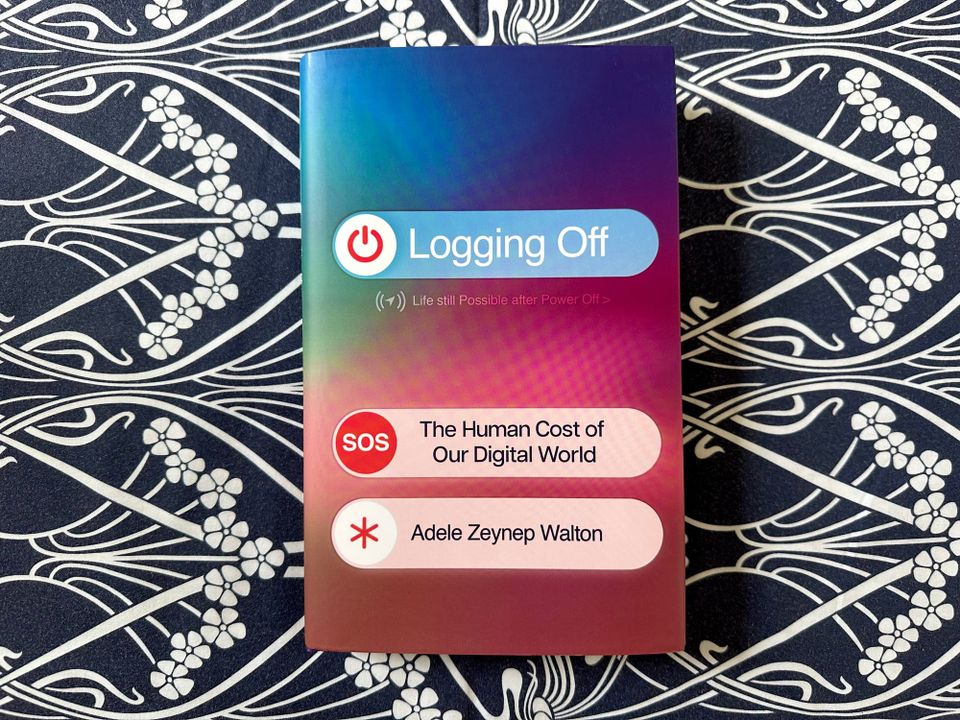
Logging Off: The Human Cost of Our Digital World (2025) is a book by the journalist and online safety campaigner, Adele Zeynep Walton. Across its eleven chapters, Walton takes us on a poignantly reflective account of the mess that unrestricted algorithmic culture has wreaked on people like her, who have had the misfortune to have grown up at the same time as when online cultures spilled out from the desktop before finding a new home on our smartphone screens.
As a self-professed part of Gen-Z, Walton takes us into the mind of someone whose formative years online were mediated by a new innovation — the algorithmic feed; we experience how her perception of self-worth has been dictated by networks that equate popularity with likes; whose online social spaces expanded at such a speed that little thought, care or control had been given to the age, identity, or motives of some users communicating with the teenagers and children taking their tentative first steps online. Walton recalls:
“I was born the year after Google was invented. I was nine when my sister and I first started playing The Sims. I was ten when my dad made my first Facebook account. I was eleven when I made my first YouTube video. I was twelve when I started photographing my clothes, posting them on Facebook and selling them in school before lessons began. I was thirteen when I first reblogged a photo of anorexic bodies on Tumblr because I thought that's what my body should look like. I was fourteen when I got my first iPhone. I was sixteen when I was photographed non-consensually by a man with his smartphone on a bus. I was eighteen when I got my first role as social media manager at a charity. I was nineteen when I was trolled on Twitter, which left me struggling with anxiety for years. I was twenty-two when I met my partner on Hinge. I was twenty-three when I lost my sister to online harms and my life changed forever.” — Logging Off, pg. 15
The motives that have led to the writing of Logging Off are deeply tragic. In the opening pages, we learn that Walton’s younger sister Aimee had taken her own life in 2022 as a result of being part of an online internet forum that discusses, encourages, and facilitates people to commit suicide. Walton tells us “there [were] over 40,000 members and 2 million posts on the suicide forum that my sister Aimee found herself on.” (pg. 19) — four times as many page views directed towards the National Suicide Prevention Lifeline. It is distressing to read the account of Aimee’s last moments. Very quickly, as our distress subsides, it crystallises into rage towards the overlapping systems, bodies, and corporations that have permitted these ecosystems to be designed and be aggressively promoted in the name of free speech absolutism, innovation, and anarchic disruption.
The Human Cost
Technology work is always concerned with measuring and controlling cost. From estimating the costs of a project team, acquiring software necessary for designing and building a service, to the central concern of steering innovation towards automation promising increased efficiency that will hopefully reduce ongoing operational costs. However, these focuses sidestep a far more fundamental cost that in all of my years working in the technology industry, I have never heard discussed in the same breath. As designers and developers, we frame our work using abstracted metrics that give little to no thought to the human costs of our work — particularly towards children who have even less agency and ability to protect themselves.
The central provocation running through Logging Off is a confrontation of the human cost of our digital worlds. Technology builders and scholars tend to overcomplicate the issues surrounding its development — a way of ensuring the exclusive hold we have on the people we deem qualified to discuss such issues — but Walton sets out the stage for this provocation by outlining that, far from being motivated by a misrepresented form of Luddism, she writes: “Logging Off is not just about spending more time offline or pouring ourselves into our lives beyond our online bubbles. It's also a rejection of the idea that we have to just accept things as they are. That online harms are just the other side of innovation and technological change.” (pg. 13).
Walton and millions of people now in their mid to late twenties have grown up under what she terms “algorithmic dictatorship” (pg. 52) — a social-technological era coinciding with the algorithmisation of most social media and other online gathering places. Walton’s first steps exploring the internet happened to coincidence with Tech acquiring the modifier ‘Big’ before moving on to capture the legislative and policy direction across the USA, UK and Europe to ensure their products evade responsibility for the social harms they have and continue to cause at scale.
Walton is deeply aware of the contradictions and tensions of using social media, because so much of our lives are mediated and experienced online. Walton recognises there are many communities that have emerged from social networks to provide solace for people seeking deeper emotional and collective connection away from our screens (pg. 77) — from Casual Readers Club to Flock Together (a birdwatching group I also regularly attend and have mentioned in my work) — it is inarguable that social media can be a catalyst for positive social connection, but the economic imperative behind services that are by-product of a surveillance capitalist economy stacks up the odds against our capability to preserve our privacy and agency in an environment designed to be, what Shoshana Zuboff writing in The Age of Surveillance Capitalism calls “a means to others' commercial ends” (pg. 9).
Radicalised Online
Walton rightly spends a significant proportion of Logging Off discussing the how young people are being radicalised online awash in an ocean of hyper-personalised algorithmically generated feeds that distribute mis- and disinformation ending up with polarising discourse fine-tuned to amplify and exploit a reader’s neuroses. We are left with a toxic situation where increasing numbers of how young boys and men are being radicalised to hate young girls and women. We witness the proliferation of deepfake abuse and revenge porn, and how young girls and women in particular develop body-image issues in pursuit of unattainable beauty standards — in what Isabelle Coy-Dibley, doctoral researcher in English, Linguistics and Cultural Studies at University of Westminster, calls digitised dysmorphia.
Facing the harms heaped upon young people seems insurmountable, but there is another demographic being radicalised who are too often overlooked in the discourse about online safety — middle-aged people. When we consider the effects of far-right radicalisation — a decades long problem in the UK, turbocharged by platforms such as X, that culminated in full scale riots during 2024 and even this summer in Belfast with hate-crimes committed against asylum seekers or anyone deemed to ‘not look British’ — it is deeply troubling how a significant number of middle-aged people and beyond are being radicalised by mis- and disinformation they have encountered online and in group chats. Sara H. Wilford, Associate Professor of Computer Science at De Montfort University argues that middle-aged people are a demographic that are all too easily made invisible in discourse about the harms of technology use, social isolation, and radicalisation:
“Middle-aged people are often bundled in with the “over 50s” as a group, which includes the very old — a demographic with whom they have little in common. The middle aged are not “digital natives” but they are online. And, crucially, they may actually be less informed about the dangers of online misinformation than younger people because they have not been the target of education in the same way. These days, significant effort is put in to educating young people about how to navigate the online world safely, but middle aged people missed the boat.” — Middle‑aged radicalisation: why are so many of Britain’s rioters in their 40s and 50s?
Despite its focus on the human cost of our networked digital worlds on teenagers and young adults — which is appropriate given the expansive scope and depth of research Walton has carried out — Logging Off stands as one of the most important books to be recently published about the individual and collective human impact of technologies that have been propagated without little constraint, often accompanied by inadequate performative controls by the companies who profit from the addiction and the endless scroll (what we in the tech industry call ‘engagement’) while evading accountability for the misery, and disinformation inflicted upon their users. Without institutional backing, Walton has proven herself willing to directly confront the political economies of Big Tech, while refusing to shy away from this notoriously knotty subject head-on with a critical clarity that successive Governments across many countries have either lacked the will, vision, depth of understanding, or sense of urgency to tackle. The paperback edition of Logging Off has just been published — coincidentally at a time when the current UK government is proposing a social media ban for under-16s — so to read Logging Off is a timely contribution to what promises to be a complex issue that will certainly need a more nuanced response than a blanket ban could adequately address.
Logging Off: The Human Cost of Our Digital World by Adele Zeynep Walton. Published in 2025 by Trapeze, 288 pages.
Talk
The Soft Power of Loneliness (2024, 18 mins) by Monika Jiang at UNFINISHED
Verse
Can We Auto-Correct Humanity? (2026, 3 mins) by Prince Ea
More from Adele Zeynep Walton
Adele Zeynep Walton is a journalist and campaigner for better online safety, and in recent months has been instrumental in increasing the urgency with which the UK Government treats this issue. She co-founded Logging Off Club as a reaction against the dominant ways in which social media defines social connection. The club continues to organise meetups and events, and so far has chapters in the UK, Australia, and Canada.
 Pocket Casts
Computer Says Maybe, 6 June 2025, 43 mins
Listen
Pocket Casts
Tech Won't Save Us, 4 April 2024, 1 hour 8 mins
Pocket Casts
The Documentary Podcast, 11 June 2024, 26mins
Pocket Casts
The Documentary Podcast, 4 January 2025, 22 mins
Pocket Casts
Search Engine, 11 April 2025, 47 mins
Pocket Casts
Overthink, 18 November 2025, 1 hour
Pocket Casts
The Bunker — News without the Nonsense, 2 December 2025, 30 mins
Pocket Casts
FT Tech Tonic, 25 February 2026, 35 mins
Pocket Casts
The Story, 15 March 2026, 36 mins
Pocket Casts
The Documentary, 16 April 2026, 29 mins
Pocket Casts
Skeptics with a K, 18 June 2026, 36 min
Transcripts are available for Loneliness and Artificial intimacy — A teenager’s last conversation.
Further reading
- The Age of Surveillance Capitalism: The Fight for a Human Future at the New Frontier of Power by Shoshana Zuboff (Profile Books, 2019, 692 pages)
- Design for Safety by Eva PenzeyMoog (A Book Apart, 2021, 143 pages, out of print)
- Middle-aged radicalisation: why are so many of Britain’s rioters in their 40s and 50s? by Sara H. Wilford (The Conversation, 2024)
- #24 My week of rest and relaxation by Eleanor Biggs (Adult Brace, 2025)
- The AI That Comes Too Close by Monika Jiang (The Oneliness Project, 2025)
- alive internet theory by Spencer Chang (spencer’s paradoxes, 2025)
- The Last Days Of Social Media by James O’Sullivan (NOEMA, 2025)
- The New Age of Sexism: How the AI revolution is reinventing misogyny by Laura Bates (Simon & Schuster, 2025, 312 pages)
- Books and screens by Carlo Iacono (Aeon, 2026)
- How tech turned against women by Laura Bates (FT Life & Arts, 2026)
- I am a 15-year-old girl. Let me show you the vile misogyny that confronts me on social media every day by Anonymous (The Guardian, 2026)
- Love Machines: How Artificial Intelligence is Transforming Our Relationships by James Muldoon (Faber & Faber, 2026, 272 pages)
- Screen time can damage under-twos’ development, landmark study suggests by Sally Weale (The Guardian, 2026)
And finally...
🎙️ NEW EVENT ANNOUNCEMENT! On Wednesday 15 July, I will be speaking at the Ecological Citizen(s) Festival held at the Museum of Making in Derby. This is a free one-day event attended by over 100 multidisciplinary guests including academics, artists, musicians, activists, ecologists, citizens scientists, VCSE workers and volunteers, community members, entrepreneurs, conservationists and more! Registration is now open.
🎙️ On Wednesday 29 July, I will be co-presenting a talk about design ethnography work I have done for the UK Parliament at TransformGov Talks — a monthly meetup for people working across the public sector in digital and service design, and policy innovation. The event is free and can be attended in-person or streamed online, but registration is required. If you are attending in-person, you will need to bring photo ID because we are being hosted by the Ministry of Justice, a UK Government building. Tickets available now.
🇦🇹 I will be speaking on day 1 of uxcon vienna from Wednesday 16 to Thursday 17 September. My talk is called Whose English gets to be default? and is about accent bias and speech recognition. Tickets available now. Use my personal code MICHAELUXCON to get 10% off!
📣 I have a chapter in the forthcoming essay collection Digital Design for Planetary Care: The Hidden Environmental Cost of the Digital World co-edited by Professors Elio Caccavale and Gordon Hush. The book will be published by Bloomsbury Visual Arts in summer 2027.
💳 If you like what you have read, please consider supporting my independent practice with a one-off £10 donation. That will be a welcome contribution towards the ongoing costs of keep this website running!
📚 You can buy any book featured in this newsletter from my page on Bookshop.org (affiliate link)
🗄️ Editions #1–15 of First & Fifteenth were published from 2023 until 2025.