Fifteenth #19: On water
London is a city of forgotten streams and lost rivers; of sedimented layers encasing ancient waterways that have long since been diverted underground; of stopped wells and springs that have fallen out of collective memory — leaving us unanchored from the histories formed by their passage.
We encounter nominal clues as we wend our way at street level or underground — residues of the waters that once shaped a different city. Westbourne, Holborn and Marylebone (St-Mary-le-bourne) for the brooks that once issued from freshwater springs; Shadwell, Sadlers Wells and Clerkenwell for the mineral-rich waters drawn from these subterranean environs.
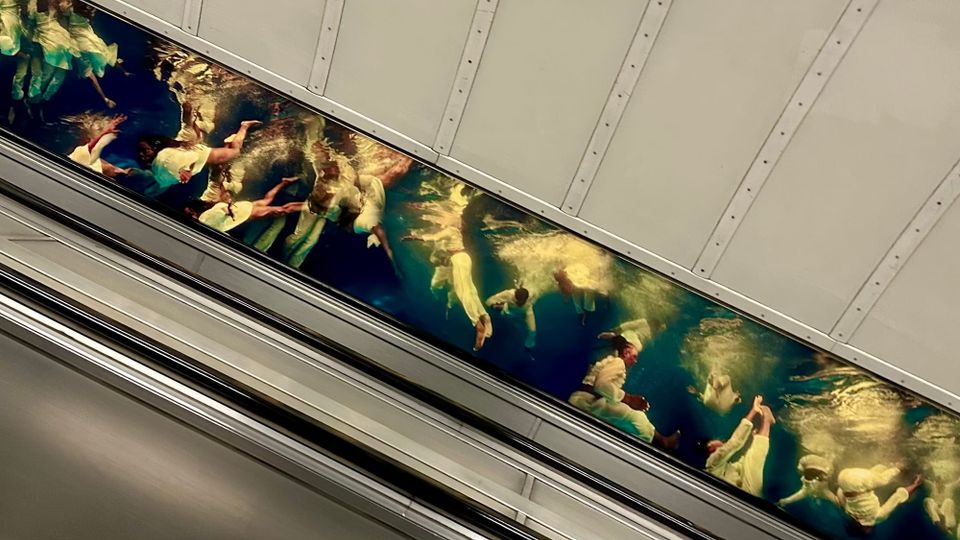
we move through scales of blue (2026) is a new art installation by the Kenyan-British artist Phoebe Boswell that fills the escalator halls in Bethnal Green station in East London and Notting Hill Gate station in West London — opposing points on the Central Line. In the East, the ancient River Walbrook would have crossed the Central Line near Bank in the ancient City of London. In the West, the Westbourne which still lends its name to its terrace, grove, and station.
we move has been commissioned by Art on the Underground — a cultural program running since 2000 to install site-specific permanent or temporary works of art, poetry and sculpture on London’s sprawling Underground network. Boswell’s work is a new addition to this cultural program, giving passengers at both stations welcome relief from the relentless onslaughts of adverts seemingly clinging to every vertical surface — products symptomatic of a fraught populace: the candy flavour vape for calm, the high energy drink for focus, the headache remedy for relief.
Boswell’s practice has flourished in recent years as she interrogates her diasporic existence across and between Kenya, the Arabian Gulf, and London. Water is an element Boswell returns to again and again — a reminder of how those of us counted as part of a global diaspora are so easily dislodged, dispersed, and disseminated from the places we call home. Our anchors are so easily washed away.
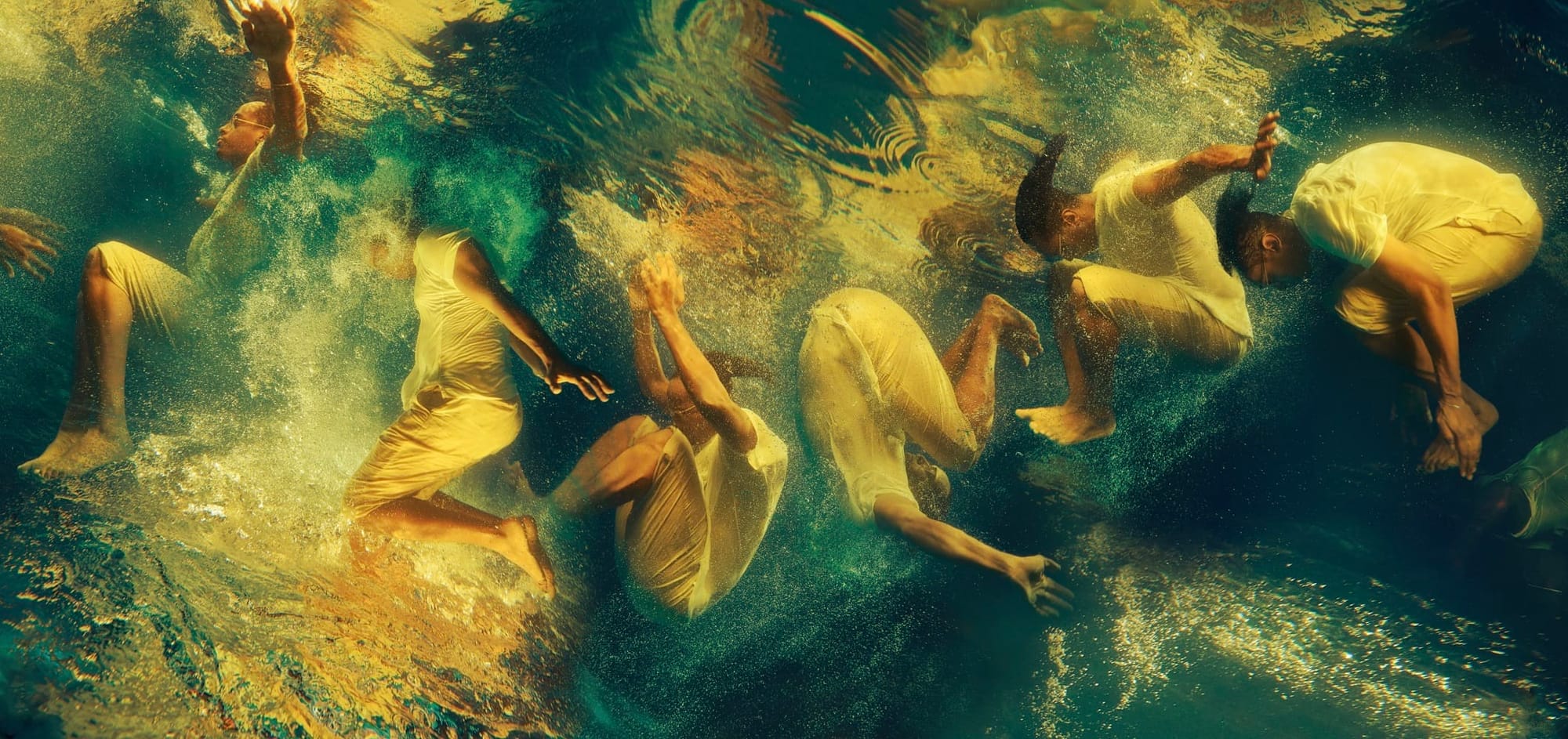
I step onto the escalator and glide deeper underground. To my left, a sequence of Black bodies suspended — frozen in time — in a series of acrobatic poses. we move is partly motivated by Boswell’s continuing concern that 96% of Black British adults don’t swim. The artwork’s photographed participants were approached through local swimming communities in and around London — subverting the too-narrow specification of who is considered worthy as a subject for artistic representation.
As I view these figures, a weight lifts from my shoulders as the escalator glide us past these frozen figures. Black bodies — so often made spectacle, and rare subjects of cultural expression in the British public realm — have been given the space to kinetically express themselves in these teal waters.
tread water
To tread water is to endure the gravitational pull exerted upon my body towards the boundaries within which I am expected to be contained. Tidal shifts drag me in a direction I do not wish to travel — exposing the ill-fitting racial-geographic frame that envelops Blackness. The contradictions of how my Blackness, Britishness and being African cohabit multiplies the layers of othering under Eurocentric Modernity. The complexity of how my personhood refuses constriction by a taxonomic frame is unsettled by its etymological origin — an oppositional binary created to define Blackness as the antithesis of Whiteness. We tread water to stay afloat.
To tread water is to regulate my breathing and movement in an ontologically hostile environment telling me to prove my creative practice to satisfy the demands of a citational economy I have no need to satiate. My practice remixes, reorders and reconstitutes ideas that do not belong; my practice tells stories to a different rhythm; my practice will be prosaic one day and poetic the next; my practice will not be withholden to the ordering, direction or discipline of a socio-citational economy that cannot see past the limitations of racial-geographic frame that I inhabit. “To unlearn citational culture is to liberate ourselves from the expectation of mechanisms that cannot adequately frame our Blackness.” We tread water to stay afloat.
under water
To be under water is to use my refracted gaze to envision greater clarity of my past, present, and futures. The residues of these island’s nautical expeditionary exploits still define our contemporary urban and economic landscapes today. From the bottom of the Atlantic, I am reminded of the imperatives that innovated to insure those ship’s cargo and how they were in service to the fidicuary responsibilities between a company and its investors. The kidnapped Africans daisy-chained and thrown overboard — a jettisoned cargo — have been lost to time, and their descendants remain in peril in our time across the Mediterranean — both too easily erased from our collective, civic, and spatial memory: there are no streets here named for the Zong. Do not lose sight under water.
To be under water is to see how the machinations of the past were culverted, its waters tamed, and technological futures built from its drained wetlands are being erected in the belief there are no consequences to the sedimented layers beneath. Leanne Betasamosake Simpson’s contribution to The City of Our Dreaming (The 2024 Alchemy Lecture), reminds me that the logics of extractive capitalism overturns the reciprocity encapsulated by Indigenous living; lakes are drained, the land is made productive and biodiversity withers: “Settler colonialism hates wetlands” (pg. 130).
To be under water is to imagine technological futures through a refracted gaze — reappraising my work as ecosystemic, that positions my interventions as memorials of the minerals, bodies, and waters consumed by these infrastructures: minerals for the material cost levied upon the planet, bodies for those unequally labouring under racial-capitalist modes of extraction, and waters for the geo-temporal memories suspended in the wake of technological expansion flowing around me. As it is in Gaza, in Congo, in Sudan and many other theatres of war waged through autonomous weapons of oppression, our futures as Simpson concludes, can and must exist in “a place that refuses colonialism as its architecture” (pg. 135). Do not lose sight under water.
Coda
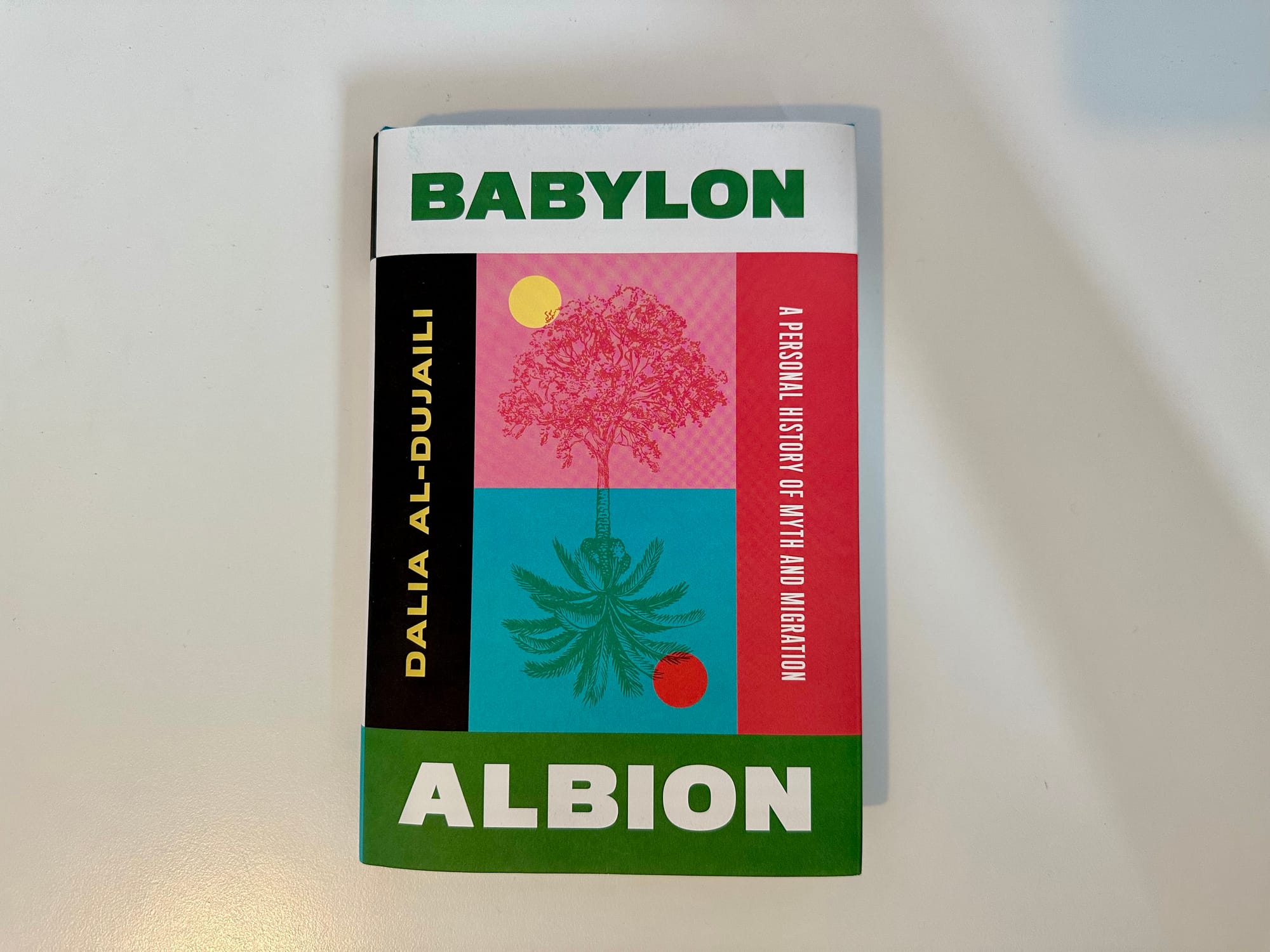
Dalia Al-Dujaili’s recently published memoir is a resonant poetic account of her life growing up between Iraq and the UK. Dalia’s relationship with water — both cultural and personal — are reverberating themes running throughout, and her words are a fitting close to this brief meandering essay:
“We can blow away the borders which never existed except on maps — young, paper-thin, flimsy things — and know ourselves here. The search for what is yours and what is mine ends. Nothing belongs to us; we share ideas, histories and stories like we share the sea. We simply borrow, and return and return.” (pg. 3) — Babylon, Albion: A Personal History of Myth and Migration by Dalia Al-Dujaili
Listen
 Pocket Casts
Emergence Magazine Podcast, 30 May 2023, 23 mins
Pocket Casts
Green Dreamer, 27 October 2023, 53 mins
Pocket Casts
Carceral Fictions & Abolitionist Realities, 8 January 2025, 59 mins
Pocket Casts
Ideas, 12 June 2025, 57 mins
Pocket Casts
Emergence Magazine Podcast, 20 May 2025, 1 hour 4 mins
Pocket Casts
Illuminated, 15 March 2026, 29 mins
Pocket Casts
Code Switch, 23 May 2026, 39 mins
Pocket Casts
Illuminated, 14 June 2026, 28 mins
Transcripts are available for BECOMING WATER: Black Memory in Slavery’s Afterlives. Zoe Todd: Embodied listening for freshwater futures, and Phantom Waterways & Unstable Geographies.
Further reading
- London Under by Peter Ackroyd (Chatto & Windus, 2011, 202 pages)
- In the Wake: On Blackness and Being by Christina Sharpe (Duke University Press, 2016, 188 pages)
- Undrowned: Black Feminist Lessons by Alexis Pauline Gumbs (AK Press, 2021, 120 pages)
- BECOMING WATER: Black Memory in Slavery’s Afterlives by Makshya Tolbert (Emergence Magazine, 2022)
- Aeropolis: Queering Air in Toxicpolluted Worlds by Nerea Calvillo (Columbia Books on Architecture and the City, 2023, 285 pages)
- E-cologies Part 2: Data Water by Alis Oldfield (Heliotrope Journal, 2023)
- These Bodies of Water: A Personal History of the British Empire in the Middle East by Sabrina Mahfouz (Tinder Press, 2022, 270 pages)
- The Alchemy Lecture 2024: The City of Our Dreaming by Laleh Khalili, V. Mitch McEwen, Gabriela Leandro Pereira, and Leanne Betasamosake Simpson, introduction by Christina Sharpe (Alchemy by Knopf Canada, 2025, 174 pages)
- Babylon, Albion: A Personal History of Myth and Migration by Dalia Al-Dujaili (Saqi Books, 2025)
- Inklings #26: Look, Don't Touch: Reflections on the Freedom to Feel by layla-roxanne hill and Francesca Sobande (404 Ink, 2025, 120 pages)
- Learning to Float by Peter Johnson (Are.Na Annual, 2026)
- Black in Blues: How a Color Tells the Story of My People by Imani Perry (Allen Lane, 2026, 256 pages)
And finally...
🎙️ NEW EVENT ANNOUNCEMENT! I will be co-presenting a talk about design ethnography work I have done for the UK Parliament at TransformGov Talks — a monthly meetup for people working across the public sector in digital and service design, and policy innovation — on Wednesday 29 July at 6pm. The event is free and can be attended in-person or streamed online, but registration is required. If you are attending in-person, you will need to bring photo ID because we are being hosted by the Ministry of Justice, a UK Government building. Tickets available now.
🇦🇹 I will be speaking on day 1 of uxcon vienna from Wednesday 16 to Thursday 17 September. My talk is called Whose English gets to be default? and is about accent bias and speech recognition. Tickets available now. Use my personal code MICHAELUXCON to get 10% off!
📣 I have a chapter in the forthcoming essay collection Digital Design for Planetary Care: The Hidden Environmental Cost of the Digital World co-edited by Professors Elio Caccavale and Gordon Hush. The book will be published by Bloomsbury Visual Arts in summer 2027.
💳 If you like what you have read, please consider supporting my independent practice with a one-off £10 donation. That will be a welcome contribution towards the ongoing costs of keeping this website running!
📚 You can buy any book featured in this newsletter from my page on Bookshop.org (affiliate link)
🗄️ Editions #1–15 of First & Fifteenth were published from 2023 until 2025.